

Dowdy-Rodgers Criticized for Mismanagement After Public-Comment Confrontation Raises Safety Concerns
Updated: Dec 10, 2025
Actions taken by San Bernardino County Board of Education President Gwen Dowdy-Rodgers during the Board’s November 10 meeting have drawn criticism from attendees following a hostile public-comment incident that raised safety concerns. Attendees reported that a speaker used his public-comment time to confront a specific attendee rather than address the Board and later shouted additional remarks after leaving the podium, conduct that prompted fears of intimidation.
Critics said the incident occurred alongside other meeting-management issues by Dowdy-Rodgers, including the invocation of meeting rules not found in published Board policies, unequal treatment of speakers, and preferential access to seating, microphones, and visibility for certain attendees. Observers said these combined actions raised broader concerns about fairness, access, and the inconsistent enforcement of public-meeting rules by the presiding officer.
Attendees also noted that Dowdy-Rodgers has served on school boards since 2014 and said her experience carries an expectation of familiarity with the Brown Act and the Board’s own public-meeting policies.
Background: Public Comment on Consulting Payments
During the meeting, a member of the public raised questions about reported consulting payments made to Sherman Garnett, a current Upland Unified School District trustee and former San Bernardino County Board of Education trustee, in connection with work for County Superintendent Ted Alejandre. Public records and prior reporting indicate that the payments to Sherman Garnett exceeded $3,000 per hour in some instances.
The size of the payments and whether long-standing professional relationships played a role in high-dollar public contracts funded with taxpayer dollars was questioned.
Confrontational Remarks Directed at a Member of the Public
Following those comments, Wil Greer, who identified himself as an educator in San Bernardino County, addressed the Board during public comment. Rather than addressing the Board or an item within the Board’s jurisdiction, Greer focused his remarks on the prior speaker.
Greer stated on the record that he had not reviewed Garnett’s contract and was unfamiliar with the details of the consulting arrangement. He also stated that he had known both Garnett and Dowdy-Rodgers for over 20 years.
During his remarks, Greer repeatedly addressed the prior speaker directly and concluded by stating:
“Who are you to question? What have you done? Have you shown up? Have you stood in the gap? If the answer to that is no, then please kindly sit down and do not come up here again.”
Under the Board’s public-comment rules and the Brown Act, remarks are required to be directed to the Board, and the presiding officer is authorized to maintain decorum and address comments directed at other meeting attendees.
Despite objections raised by members of the public during Greer’s remarks, President Dowdy-Rodgers did not interrupt or redirect the speaker to address the Board. Instead, she issued a warning to attendees who objected to the remarks, rather than to the speaker making them.
Several attendees said this response left them uncertain how public-comment rules were being applied by Dowdy-Rodgers and why objections to personal remarks were met with admonishment while the remarks themselves were not addressed.
Dowdy-Rodgers’ Failure to Intervene Following Allegations of Misconduct
Witnesses reported that after leaving the podium, Greer walked past the prior speaker and shouted additional remarks. Immediately afterward, another public commenter raised concerns on the record about the interaction and potential safety issues, stating:
“Before I begin, I would like to just note that after a public commenter spoke, they came over and yelled in [a member of the public's] face. So you guys need to discuss that because that is not okay. We’ve experienced that before with Mr. McEachron. We got threatened for making PRAs, and we should not be accepting this kind of abuse. So, we want to talk about the civility laws, and then you allow someone to come and scream in somebody’s face. This is a public meeting and you’re supposed to make people welcome.”
President Dowdy-Rodgers interrupted and attempted to redirect her to the agenda item. The commenter responded:
"I need to be able to state a safety concern, thank you."
The commenter then continued with her remarks. Attendees later said that President Dowdy-Rodgers did not pause the meeting, address the safety concern, or make any statement regarding decorum or public safety, raising additional questions about how meeting order was being maintained.
Who Is Seen and Who Isn’t: Camera Placement and “Board Space”
Concerns about meeting management had surfaced earlier in the afternoon.
Prior to the start of the meeting, President Dowdy-Rodgers directed the Board’s legal counsel to ask a member of the public to remove a tripod-mounted camera, stating that it had been placed in “board space.” No policy citation was provided at the time despite repeated requests.
Shortly thereafter, before roll call, President Dowdy-Rodgers addressed the room, stating:
“Before we take our roll call, we will make a statement. In my observation, there is a camera to my right in our board member space. Throughout the meeting there is public space versus non-public space, so we will be reviewing the policies to ensure that we stay in compliance. I don’t know who the individuals are, but I want to make sure the rest of the Board is aware that there is a recording. So, I want to make sure the rest of the board is aware of the camera that is to my right.”
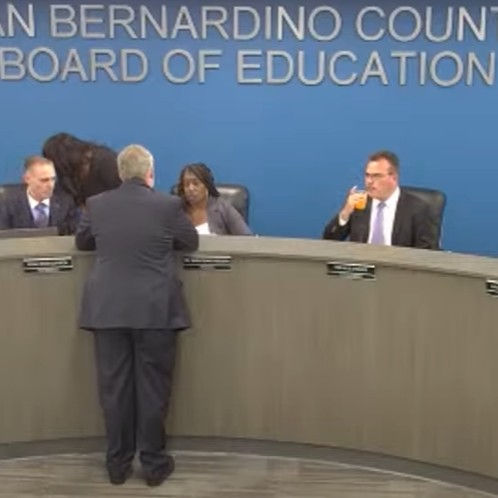
The statement was made without any discussion, motion, or vote by the Board, and no agenda item or recorded Board action accompanied the statement.
A review of the San Bernardino County Board of Education’s publicly available policies and rules governing public meetings and media access did not identify any provision defining a separate area referred to as “board space" or otherwise distinguishing between public and non-public areas within the meeting room.
The Brown Act likewise does not define “board space,” instead allowing public agencies to adopt reasonable, content-neutral rules to prevent disruptions or interference with the conduct of meetings.
Attendees questioned how Dowdy-Rodgers could speak on behalf of the Board without a recorded vote or other formal action, leaving unclear whether the statement reflected an authorized Board decision.
Preferential Treatment of Employees and Allied Speakers
Attendees stated that the seating and room arrangement observed on November 10 was consistent with how County Board meetings are routinely configured.
At each meeting, San Bernardino County Superintendent of Schools (SBCSS) employees—who are not members of the San Bernardino County Board of Education and are employees of a separate legal entity—are seated at draped tables positioned directly between the Board dais and the public seating area. The setup includes individual tabletop microphones, nameplates, and large rolling, high-backed office chairs, similar in appearance to official board seating. Attendees further noted that some tables are equipped with individual space heaters underneath, underscoring the level of accommodation provided.

The placement and size of these tables occupy at least half of the available meeting room, leaving a small cramped area in the back of the room for members of the public. Observers said this configuration visually separates the Board from the public and limits where members of the public can sit or position themselves within the room.
SBCSS employees are permitted to speak from their seats and use individual microphones. Because the official meeting video records only speakers who stand at the podium, these employees appear off camera, facing the Board with their backs to the public. As a result, viewers of the recording hear voices without seeing the speakers’ faces and in-person attendees only see the backs of the employees.
By contrast, members of the public are required to approach the podium, state their names per board policy, remain on camera, and adhere strictly to time limits. Attendees noted that individuals using wheelchairs are not consistently visible on the official recording, as the camera captures only those who are able to stand at the podium.

Observers said the recurring use of draped tables, individual microphones, nameplates, and high-backed chairs by SBCSS employees creates the appearance of reserved seating and institutional authority, despite those individuals having no governing role on the County Board. Several attendees commented that this arrangement results in named, visible public speakers addressing the Board, while unnamed and unseen voices from SBCSS employees speak from the preferential seating in the front of the room.
Critics said these repeated practices raised questions about the allocation of public resources, the consistent application of meeting rules, and whether the physical setup aligns with Board Policy 116, which emphasizes impartial governance and avoidance of preferential treatment. Attendees added that the arrangement blocks sight-lines and creates the appearance that members of the public are intruding on an SBCSS meeting rather than participating in a meeting of the governing Board.
Presiding Officer Ethics and the Duty to Ensure Fair Process
Board Policy 116 — Governance Standards and Ethical Conduct emphasizes that Board members must operate openly and with integrity, ensure opportunities for diverse viewpoints to inform Board deliberations, and avoid preferential treatment.
Attendees said that the combination of issues raised during the meeting — including statements suggesting a member of the public’s camera placement was inconsistent with policy without identifying any such policy, allowing certain speakers enhanced access to seating and microphones, and declining to intervene during personal remarks directed at a member of the public — raised questions about whether the meeting was properly facilitated and whether board procedures were applied consistently by Dowdy-Rodgers.
Several speakers emphasized that these concerns relate specifically to the Board President’s role in maintaining order, enforcing rules uniformly, and ensuring equal access to the forum, particularly when individuals addressing the Board have long-standing professional or personal relationships with Board leadership, including Greer’s reported 20-year affiliation with Dowdy-Rodgers.
First Amendment Considerations Raised by Attendees
Attorneys and civil-liberties organizations have long noted that while government bodies may adopt reasonable, content-neutral rules to maintain order at public meetings, the First Amendment prohibits viewpoint discrimination — meaning officials may not favor supportive speech while suppressing or discouraging critical viewpoints.
Several attendees said they were concerned that warnings were directed at members of the public who objected to personal remarks, rather than at the speaker making them, and that criticism of public spending appeared to be treated differently than praise for Board leadership.
Escalating Safety Concerns Following Board Meetings
Concerns about meeting conduct and public safety emerged over a series of County Board of Education meetings beginning in September. At that meeting, Trustee Ryan McEachron proposed creating a public “debt clock” to track the cost of responding to public records requests, stating that the purpose would be to “shame” individuals who submit such requests. In the same remarks, McEachron added that while the Board itself could not act, “there are others who can,” a statement many attendees interpreted as encouraging action against members of the public.
Observers said the tone of subsequent meetings shifted noticeably. At later meetings, several speakers directed comments at other members of the public—questioning their motives, credibility, or presence—rather than addressing items within the Board’s jurisdiction. Attendees noted that many of these speakers had professional or personal ties to SBCSS or Board leadership and that the remarks were allowed to continue without intervention by Board President Gwen Dowdy-Rodgers, even when concerns were raised about confrontational or personal commentary.
After the October meeting, the conduct extended beyond the meeting room. Attendees reported that photographs and video of private citizens were taken and circulated online. The accompanying posts characterized public commenters as political extremists and portrayed Board meetings as hostile or dangerous.
Community members emphasized that concern arose not only from the posts themselves, but from the volume of comments and endorsements that followed, including reactions from individuals identified as current or former SBCSS employees, the wife of County Superintendent Ted Alejandre, and the sister-in-law of Board President Dowdy-Rodgers.
Following the November meeting, where a member of the public was confronted during public comment without corrective action from Dowdy-Rodgers, attendees said the online rhetoric escalated further. Posts and comments referred to public speakers as “extremists” and “terrorists” and encouraged others to attend future meetings “in great numbers.”
Attendees and observers said the progression—from targeting records requesters, to hostile public comment aimed at private citizens, to online identification and extremist labeling—created serious concerns about intimidation and safety, particularly given the lack of intervention during meetings. Multiple community members contacted law enforcement and the District Attorney’s Office and requested the presence of security at future meetings, citing fears of retaliation and the inability to participate freely in public comment without being targeted or identified outside the meeting.
The concerns have placed renewed focus on County Board of Education leadership, questions about consistent enforcement of standards, and whether future meetings will address both public safety and equal access to the forum.
EdWatch reached out to Board President Gwen Dowdy-Rodgers for the opportunity to provide comment. She did not provide a response by the deadline.

Comments