

PART 1: Invisible Bonds: How Two County Superintendents Exercise Cross-County Authority Over 64 Independent Agencies Through the Inland Personnel Council (IPC)
Updated: May 20
Are school districts beholden to a decades-old, auto-renewing Joint Powers Agreement that states they are “bound by” an ever-evolving contract they’ve never signed?
This is Part 1 of an ongoing series examining the structure and operations of the Inland Personnel Council (IPC).
Part 1 Continued: Behind-the-Scenes IPC Dissolution and "Reorganization" Deepen Transparency Concerns
(Please note that this is a constantly changing story as new documentation is provided and included in the post. Please check back for updated information.)
Update 4-17-26: Temecula Valley School Board votes to discontinue its Inland Personnel Council contract at the April 16, 2026 board meeting, citing conflict-of-interest concerns and questions about the enforceability of an "auto renew" policy. See the discussion and vote on the board meeting video at approximately the one hour mark.
Update 4-23-26: Members of the public denied access to IPC Meeting.
Update 4-23-26: Executive Officers, Gomez and Alejandre, provide conflicting responses about the Inland Personnel Council. Legal representation for Gomez cites "confidentiality" under the Brown Act for withholding IPC records while Alejandre disputes IPC being subject to the Brown Act.
Update 5-6-26: Director of IPC (a Joint Powers Agreement) or Private Law Firm Employee/Consultant? Conflicting Public Records Emerge
Update 5-6-26: IPC Advisory Committee is removed from website
Update 5-6-26: IPC abruptly cancels May 8, 2026 3rd General Meeting amid public scrutiny
UPDATE 5-20-26: PART 1 CONTINUED: Behind-the-Scenes IPC Dissolution and “Reorganization” Deepen Transparency Concerns
The Inland Personnel Council (IPC) operates across dozens of public agencies, multiple contracts, and two counties—but the agreements that define how it actually functions are not clearly presented to governing boards or the public.

What is often described as a simple Joint Powers Agreement is, in practice, a layered contractual structure that determines how districts receive legal services and how those services are directed across agencies.
At its core, the issue is not whether districts chose to participate at some point in time, but whether current governing boards understand the agreements that continue to bind them—and the authority those agreements place in the hands of two county superintendents.
What IPC Is — and What It Appears to Be in Practice
The Joint Powers Agreement defines IPC as a “group of school districts,” suggesting a limited cooperative arrangement among independent agencies.
According to the IPC website, the Inland Personnel Council has existed since approximately 1980. Over time, it has evolved into a cross-county structure in which two county superintendents direct legal services across dozens of independently governed agencies.
That structure—and the contracts that support it—are where the real questions begin.
This article examines three interconnected issues: the two-part IPC contractual structure, the separate district agreements with the law firm Atkinson, Andelson, Loya, Ruud & Romo (AALRR) that may be contributing to confusion, and the lack of transparency surrounding how these systems operate.
Visual Branding Adds to the Confusion

The IPC logo further contributes to the confusion. By displaying “IPC” alongside “RCOE • AALRR • SBCSS,” it creates the impressi on that the Joint Powers Agreement is a formal partnership between these entities. However, IPC is defined as a group of school districts—not an entity formed by county offices and a private law firm.
This visual branding reinforces the conflation between the governing structure and the vendor, making it more difficult to distinguish between the governing structure and the vendor providing services. The IPC website footer contains the logos of the three entities next to a ‘© 2026 AALRR, Inc.’ copyright notice.
LAYER ONE: THE JOINT POWERS AGREEMENT BETWEEN DISTRICTS
The Joint Powers Agreement defines the Inland Personnel Council (IPC), or “the Council,” not as a separate entity, but as “the school districts, as a group,” which also includes the San Bernardino County Superintendent of Schools (SBCSS) and the Riverside County Office of Education (RCOE) as participants.
In other words, IPC is not established as an independent organization—it is simply the collective name for the participating districts.
Yet in practice, IPC appears to function as something more. IPC issues invoices, is listed as a vendor in district accounting records, receives funds, coordinates services, and is described as employing a Director. Those are functions typically associated with an entity.
That disconnect raises a fundamental question: if IPC is only a “group of school districts,” what is the legal basis for it operating as if it were one?
The stated purpose of the Council reflects a more traditional cooperative model:
“The purpose of the COUNCIL shall be to seek and share expert legal services and advice on matters relating to personnel and employer-employee relations, to communicate among the member districts in seeking solutions to such problems, and to study and review the problems unique to employer-employee relations.”
However, the structure of the agreement itself raises additional questions.
The Joint Powers Agreement states that it is entered into by the school districts “designated below.” Yet no other districts are identified in the document. There is no clear mechanism for identifying all participating agencies, nor any provision requiring notification when agencies join or withdraw. As a result, a district may enter into—or remain part of—an agreement without knowing all of the other parties involved.
The only known record of IPC District Members appears on the IPC website, where the membership includes all 64 school districts, college districts, Regional Occupation Programs (ROPs) in the two counties. This membership list has remained completely static for over a decade according to internet archives.
In many cases, governing boards last approved this Joint Powers Agreement decades ago. Because the agreement includes an unusual automatic renewal clause, it continues in effect year after year without being brought back to current boards for review, discussion, or approval in open session.
This means current boards may be bound by an agreement they did not vote on, may not have reviewed, and may not even realize is still in effect—even as membership dues continue to be paid, often on a semi-annual basis, and potentially without clear board awareness.
See the sample Joint Powers Agreement below.
Missing Bylaws: The Critical Operational Component Cannot Be Found
The Joint Powers Agreement does not operate on its own. It explicitly contemplates the existence of bylaws that govern how the Inland Personnel Council functions.
Those bylaws are not a minor administrative detail—they are the rules that define how the structure actually operates. They would be expected to address fundamental issues such as how decisions are made, how the Advisory Committee functions, how members are appointed or removed, how meetings are conducted, how funds are managed, and how authority is exercised within the Council. They would also be expected to be attached to the Joint Powers Agreement as a critical component of the contract.
The importance of those bylaws is underscored by inconsistencies in the publicly available descriptions of IPC governance. The Joint Powers Agreement states that the Advisory Committee consists of the two Executive Officers and two appointed representatives from each county. By contrast, the IPC website states that IPC is directed by representatives of each County Superintendent, a district superintendent, and a Human Resources administrator from each county.
Without the IPC bylaws, there is no meaningful way to verify the Advisory Committee’s actual composition, appointment process, quorum requirements, governing authority, or which description accurately reflects how IPC operates in practice.
Yet, the bylaws do not accompany the Joint Powers Agreements, and there are no public record of the bylaws that has been discovered via public records and extensive searches of online board agendas.
That absence is critical.
Without the bylaws, governing boards do not have access to the rules that define how the structure actually operates. Those rules would establish how services are directed by the County Superintendents in their roles as Executive Officers, how decisions are made—including how funds are controlled and allocated—how Advisory Committee members are selected and how that Committee influences those decisions, and how authority is delegated within the structure, including who is empowered to act on behalf of participating districts and under what limits.
Without access to these governing rules, boards cannot fully understand who is making decisions, how those decisions are made, or the extent of the authority they may have already ceded.
In practical terms, districts appear to be participating in a structure without having access to the governing framework that explains how that structure functions.
This raises a fundamental problem of oversight and public transparency. Governing boards cannot meaningfully evaluate, approve, or continue participation in an agreement when the operational rules that give that agreement effect have not been provided.
It also raises a threshold legal question: if the bylaws are referenced as part of the structure but have not been produced, can districts be said to have knowingly agreed to the full terms of participation?
At a minimum, the absence of bylaws prevents informed decision-making.
More fundamentally, it raises the question of whether districts can or should continue to participate in a structure whose governing rules have not been made available for review.
Districts “Bound By” an Unseen and Ever-Changing Contract
The Joint Powers Agreement does more than establish participation—it incorporates a second contract executed only by the County Superintendents and Atkinson, Andelson, Loya, Ruud & Romo (AALRR), without any clear evidence that participating districts have reviewed—or even seen—this critical operational component of the structure.

It provides that the Executive Officers “shall execute an Agreement for Special Services… on behalf of COUNCIL members,” and that this agreement may be amended annually.
The Joint Powers Agreement further requires that “continuing COUNCIL members agree to comply with and be bound by the provisions of the Agreement for Special Services then in effect.” That language is critical - and disturbing.
It means districts are agreeing in advance to be bound by a separate contract they do not sign, may not have seen, and that can be continually changed over time without direct knowledge or approval by their governing boards - or the public.
In practical terms, the structure allows the core terms governing services, fees, and obligations to be continually modified by the County Superintendents and a private law firm in a separate contract, with those changes automatically binding districts regardless of whether those districts review or approve them.
This is not a static agreement—it is an evolving one, with terms that can change while participation remains automatic, limiting transparency into the actual terms governing the Joint Powers Agreement.
These changes to one contract lead to inconsistencies between the agreements and further complicate the structure. For example, the Joint Powers Agreement specifies that participation is limited to “school districts.” Yet the IPC website now includes additional entities such as community college districts and Regional Occupational Programs (ROPs), without corresponding changes to the original Joint Powers Agreement signed by the school districts.
This creates the potential for conflicting or inconsistent terms between the Joint Powers Agreement and the county-level Agreement for Special Services.
Authority Shifted to County Superintendents
The Joint Powers Agreement grants substantial authority to the County Superintendents—Ted Alejandre of San Bernardino County and Edwin Gomez of Riverside.
Under the agreement, they are authorized to determine membership dues, create bylaws governing operations, select legal counsel, appoint and participate in the Advisory Committee, and direct services across all participating agencies. The agreement also authorizes the transfer of funds from district accounts.
County superintendents do have statutory responsibilities under Education Code section 1240, but those duties are limited. They do not serve as the governing boards of independent school districts, and nothing in section 1240 appears to authorize two county superintendents to jointly dictate services, fees, and contractual terms for dozens of separate agencies across county lines.
This creates a clear tension between the authority exercised under the IPC structure and the statutory limits placed on county superintendents under California law.
Withdrawal: Limited Ability to Exit the Agreement
If districts are bound to evolving terms—and those terms are unknown and controlled at the county level—the ability to exit the agreement becomes critical.
However, withdrawal from the IPC Joint Powers Agreement is not automatic.
It requires formal board action and written notice to both County Superintendents—one of whom may be outside the district’s own county—by a specific deadline each year.
In effect, a locally elected governing board must request withdrawal from officials of county agencies that do not govern that district.
This raises a fundamental question: what authority do the County Superintendents have to allow or restrict an independently elected school board from deciding that the IPC agreement is no longer in the best interest of its local constituents?
LAYER TWO: THE AGREEMENT FOR SPECIAL SERVICES
This agreement is executed by the County Superintendents and the law firm Atkinson, Andelson, Loya, Ruud & Romo (AALRR)—the service provider selected by the County Superintendents—but not by the districts themselves.
Under the Joint Powers Agreement, districts have granted authority to the County Superintendents, who in turn execute this agreement on their behalf. Through that structure, the County Superintendents—and the vendor they have selected—are authorized to define and amend the terms governing services provided to participating districts.
It defines the services provided, membership pricing, and the overall structure of the program. Critically, it allows AALRR, as a vendor and party to the agreement, to participate in amending those terms on an annual basis.
That point is not theoretical—it is how the agreement has actually evolved.
Because districts are already required, under the Joint Powers Agreement, to “comply with and be bound by” whatever version of this agreement is in effect, changes made at the county level—including those shaped or amended by the vendor—may become binding on districts without their approval or awareness.
In practical terms, a vendor - AALRR in this case - is able to participate in revisions to the terms of an agreement that 64 individual districts are contractually obligated to follow.
This raises concerns about whether governing boards are receiving sufficient information to exercise informed fiscal oversight. Governing boards are tasked under the Education Code with oversight of public expenditures, yet taxpayer funds may be committed to evolving services and costs that are not clearly presented to the board. If the terms themselves can change without review, the ability to exercise meaningful oversight is called into question.
Termination and the Practical Limits on Exit
The structure of the Agreement for Special Services also raises concerns regarding termination of the Joint Powers Agreement.
The county-level contract provides that termination requires collective action by a majority of participating agencies across both counties, creating a significant practical barrier to exit.
There is no clear mechanism for school districts, community college districts, and Regional Occupational Programs (ROPs) to jointly deliberate or vote on continuation or termination of the agreement across two counties.
Without a clear legal pathway for dissolution, this structure becomes self-perpetuating, with no clear or workable avenue to ever end this publicly-funded agreement.
The 2020 Addendum — When Amendment Authority Was Used
The ability to amend the agreement is not simply a clause—it has been exercised-without clear notice to districts.
In 2020, the Agreement for Special Services was significantly expanded through a four-page addendum, effectively doubling the length of the original contract. This addendum was executed at the county level and signed only by the County Superintendents and AALRR.
This was not a minor clarification or administrative update. It was a substantial expansion of both services and authority.
The addendum introduced new categories of services, expanded the role of AALRR, and increased the scope of the firm’s involvement across participating districts. It added provisions requiring arbitration of disputes, expanded billing practices, and introduced additional fees and cost structures that were not present in earlier versions.
One of the most consequential changes was the integration of investigative and post-investigative roles. Under the addendum, an attorney who conducts or is involved in an investigation may later be required to prepare for, testify in, or otherwise participate in litigation, arbitration, or related proceedings arising from that same matter.
That shift is significant. It moves the structure beyond a traditional advisory or training model into a system where the same firm may be involved at multiple stages of a matter—training, initial complaint review, investigation, post-investigation services, and litigation—potentially across multiple entities.
The addendum also includes joint representation provisions, allowing AALRR to represent multiple parties within the same matter under certain conditions. It further expands consulting and advisory services into areas that may overlap with internal district functions.
In addition, the addendum modifies the financial structure of the agreement. It allows for expanded billing practices, including consulting-related charges and percentage-based fees, and introduces financial terms that directly affect how costs are allocated across participating districts.
All of these changes were implemented without direct approval or signatures from the district governing boards, yet according to the Joint Powers Agreement, the districts must "comply with" and are "bound by" these terms - even if unknown.
This agreement also introduces a pricing structure tied to legal services, including discounted hourly rates offered through separate AALRR contracts and conditioned on IPC membership—an element that does not appear in the original Joint Powers Agreement.
This has created significant confusion between IPC’s role as a training and coordination structure and AALRR’s role as a provider of legal services. The discounted pricing appears to arise through separate AALRR legal services agreements tied to IPC membership, rather than through IPC itself as a standalone entity.
This distinction is not clearly reflected in public-facing materials. For example, the IPC website states that IPC “provides member districts with legal services… [including] legal support for the areas of facilities, student services and special education.” However, those “adjunct services” are not provided by IPC as a Joint Powers Agreement. They are legal services performed and billed by AALRR under separate contracts.
The fact that the IPC website is created and maintained by AALRR, and includes descriptions that attribute legal services to IPC rather than to the law firm providing them, raises concerns about transparency and whether the structure is being clearly and accurately presented to participating districts and the public.
A Fundamental Question of Authority
Taken together, these provisions reflect a significant - and potentially troubling - departure from the original framework approved by districts under the Joint Powers Agreement.
Under the IPC structure, the law firm Atkinson, Andelson, Loya, Ruud & Romo (AALRR)—acting as a vendor—can amend the contract while districts remain obligated to “comply with and be bound by” the current version. In effect, AALRR has participated in drafting and revising contract terms—including through the 2020 and 2023 addenda—that expand the scope of services available under the agreement, including provisions that may financially benefit the law firm.
This raises serious concerns about authority and conflict of interest, particularly where independent governing boards did not review or approve those changes.
Whether those provisions are enforceable under California law remains an open question.
OPTIONAL OVERLAY: DIRECT AALRR CONTRACTS AND THE MISSING COST-BENEFIT ANALYSIS
Separate from IPC, many districts also enter into direct legal services contracts with Atkinson, Andelson, Loya, Ruud & Romo (AALRR). These contracts exist outside the Joint Powers Agreement, but overlap with IPC in ways that create significant confusion about how the system operates.
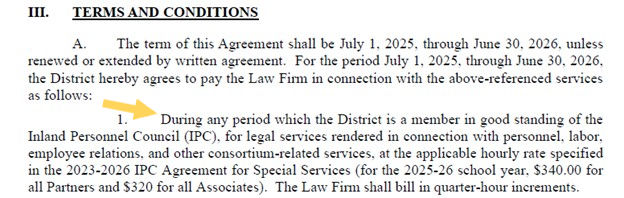
In many cases, these district-level contracts tie billing rates directly to IPC membership. For example, some agreements provide that legal services will be billed at discounted rates only “during any period in which the District is a member in good standing of the Inland Personnel Council.”
This “discounted rate” structure is not incidental—it functions as the mechanism linking IPC membership to AALRR’s legal services. While IPC is presented as a collaborative arrangement for training and coordination, this pricing linkage effectively connects it to the law firm’s separate legal services contracts.
As a result, IPC participation becomes directly tied to access to discounted legal services from AALRR, even though IPC itself does not provide those services and the contracts are legally separate.
In practical terms, IPC has shifted away from the collaborative training structure originally contemplated by the Joint Powers Agreement toward a system in which membership is linked to discounted legal services from a specific vendor—AALRR.
In practice, this overlap has led to widespread confusion. Some districts believe they are receiving discounted services through IPC while simultaneously asserting they are not members. Others appear to believe that access to AALRR services at favorable rates requires IPC participation. Public records reflect uncertainty among districts about whether they are members, whether they are paying dues, and how those payments relate to the services they receive.
This single board document from Temecula Valley Unified School District (below) reflects this confusion in a series of fundamental inconsistencies in how the Inland Personnel Council (IPC) is described. It first presents IPC as providing “member discounts with legal services, advice and professional development,” framing it as a discount program. It then states that “the Inland Personnel Council has increased their hourly billing rate for direct legal and representational services,” attributing legal billing rates to IPC. Finally, it identifies membership fees as “payable to the Inland Personnel Council,” treating IPC as if it were a standalone entity capable of receiving funds.

These descriptions cannot all be true. Under its Joint Powers Agreement, IPC is defined only as a “group of school districts,” funded through membership dues set by its Executive Officers—not a law firm, not a billing entity, and not clearly established as a separate legal entity. Legal services are performed and billed by the law firm Atkinson, Andelson, Loya, Ruud & Romo (AALRR), either through the IPC structure or through separate contracts. Presenting IPC as a discount provider, a source of hourly billing rates, and a payee in the same document blurs these distinctions and creates confusion about who is providing services, who is setting hourly rates for AALRR direct legal services, and where public funds are actually going.
No Clear Cost-Benefit Analysis of Public Funds
Despite these overlapping agreements, there appears to be little evidence that governing boards—or the public—have been presented with a clear cost-benefit analysis.
At a minimum, such an analysis would compare:
the cost of IPC membership
the actual dollar value of any legal “discounts”
the cost of attending IPC trainings and conferences as members versus non-members
and the cost of obtaining comparable services from other law firms
Public records also show that IPC conferences are held at resort and spa locations, with hotel rates of approximately $350 per night, and agendas that include “Attorney Time - Cocktail Hour”—all funded with public dollars.
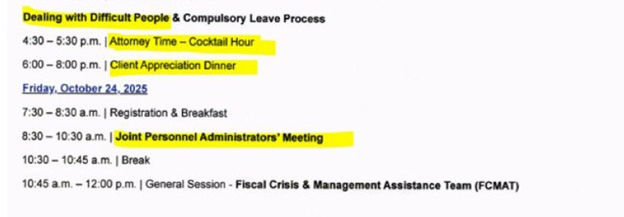
These two records below raise significant concerns about transparency, financial control, and basic fiscal oversight. The email from an AALRR employee instructs district attendees not to book hotel accommodations directly, but instead requires that they book through "IPC's registration system." The purchase order shows the district paying “Inland Personnel Council”—with an AALRR email contact—rather than the hotel itself.
The question becomes, are districts paying AALRR for these resort stays at IPC conferences rather than paying the hotel, and if so, why?
This structure is atypical and obscures who is actually receiving and processing public funds for lodging, while also conflicting with representations that IPC is not a formal entity and maintains no financial accounts. Compounding these concerns, the Redlands Unified School District purchase order is dated February 2026 for a conference held in October 2025, indicating after-the-fact authorization of an already-incurred expense.
These issues lead to questions as to whether governing boards had any meaningful visibility into or authorization over how public funds were being spent.
 |  |
Are these costs being factored into any meaningful cost/benefit analysis, and do these expenditures truly result in a “public benefit” justifying the use of taxpayer funds?
Without a clear accounting of how these expenses are structured, billed, and ultimately paid—including lodging routed through IPC rather than directly to vendors—it is difficult to determine whether IPC participation yields measurable savings or simply redistributes costs within a system that lacks transparency and effective oversight.
A Structural Conflict in Evaluating the System
Compounding the issue, the same firm that participates in and benefits from this structure often serves as legal counsel to the districts attempting to understand it.
As a result, governing boards seeking guidance on whether IPC participation is necessary, lawful, or financially beneficial may be relying on the very firm embedded within that structure to provide that analysis.
This raises a fundamental question:
How can governing boards make informed decisions about public expenditures when the agreements determining those costs are layered, interdependent, and not clearly presented for independent review?
AALRR also advises and coordinates district responses to public records requests, raising additional concerns about whether the same firm involved in structuring and delivering these services may also be involved in advising agencies regarding public disclosure obligations relating to IPC records and operations.
CONCERNS ABOUT IPC’S LACK OF TRANSPARENCY AND FAILURES OF OVERSIGHT
IPC Director and Conflicts of Interest

The IPC website states that IPC employs a part-time Director, identified as Jeff Malan. Employment requires an entity with authority to hire, supervise, and compensate, along with oversight and accountability from a governing body.
If IPC is defined in its Joint Powers Agreement as a “group of school districts,” how does that “group” employ a Director?
Here, those elements are not clear. There is no readily identifiable public record showing which governing board authorized the position, how the Director was selected, who supervises the role, or how it is funded. If IPC is not a separate entity, those questions become more significant. In addition, the "IPC Assistant" appears to be an AALRR employee, again reflecting overlapping roles involving AALRR within the IPC structure.
Additional concerns arise from overlapping roles. Mr. Malan was recently appointed to the Board of Directors of the Barstow Community Foundation, which raises funds for Barstow Community College—an IPC member. Malan's Foundation biography does not disclose his current role as IPC Director, a position he has held since 2023.
These overlapping roles raise questions about transparency, disclosure, and potential conflicts of interest. More broadly, they highlight a recurring issue within the IPC structure: roles, authority, and relationships are not clearly defined or publicly documented, making it difficult for governing boards—and the public—to understand who is making decisions, under what authority, and in whose interest.
Update 5-6-26: Director of IPC (a Joint Powers Agreement) or Private Law Firm Employee/Consultant? Conflicting Public Records Emerge
The IPC website states that IPC “employs a part-time Director,” while IPC is defined as a “group of school districts” entering into a Joint Powers Agreement. This implies a formal employment relationship within a public interagency structure. However, conflicting records suggest that Jeff Malan may instead serve as a consultant or representative associated with Atkinson, Andelson, Loya, Ruud & Romo (AALRR), rather than as a public employee directly employed by IPC member agencies.
As of May 2, 2026, a LinkedIn profile identifies Jeff Malan as “Director, Atkinson, Andelson, Loya, Ruud & Romo (AALRR),” the private law firm that provides IPC legal services and trainings and hosts the IPC website. This time period overlaps with his identification as IPC Director.
In addition, in a letter dated May 4, 2026, Jenny Owen, the SBCSS Director of Communications and Intergovernmental Relations explicitly states that Jeff Malan is "a consultant who contracts with the law firm, Atkinson, Loya, Ruud & Romo (AALRR)." She further notes that "SBCSS has no involvement in that contract."

These descriptions appear inconsistent. The IPC website states that Mr. Malan is employed by the Inland Personnel Council, while other records—including a LinkedIn profile and a letter from Jenny Owen on behalf of SBCSS—describe him as associated with AALRR. As a result, it is difficult to determine whether the “IPC Director” role is a position within the Joint Powers structure itself or a function performed through the law firm providing IPC-related services.
Mr. Malan is also listed as "Advisor, Inland Personnel Council" on the San Bernardino County School Boards Association Boardsmanship Committee.

If Mr. Malan is employed by AALRR or is contracted as a consultant, then the “IPC Director” role would appear to be performed in his capacity as an employee/representative of that law firm, coordinating trainings for IPC member districts, where that law firm provides the presentations.
His role as an "Advisor" to the SBCSBA Boardsmanship Committee would likewise involve participation in discussions regarding trainings delivered by the same law firm which employs or contracts with him.
The Joint Powers Agreement governing IPC does not identify a Director position and instead provides that the Council is governed by its Executive Officers and Advisory Committee. It also does not set forth any authority or mechanism for IPC to hire or employ staff.
This confusion of roles is also reflected in publicly presented Boardsmanship training materials. In a training video, San Bernardino County Superintendent of Schools Ted Alejandre states that the program is provided “courtesy of our partners at the Inland Personnel Council through Atkinson, Andelson, Loya, Ruud & Romo.”
This description differs from the Joint Powers Agreement, which identifies the County Superintendent as an executive officer of IPC, a member of its Advisory Committee, and the elected official overseeing an IPC member agency—not a separate “partner.”
Update 5-6-26: IPC abruptly cancels May 8, 2026 3rd General Meeting
IPC abruptly canceled its May 8, 2026 “3rd General Meeting” shortly after members of the public began raising concerns regarding IPC governance, transparency, and public participation. The meeting had been scheduled at the SBCSS Dorothy Inghram Learning Center and included programming on legislation and school employee misconduct matters, including child abuse prevention.
The registration materials also reflected an $80 fee for “nonmembers.” Previous events have listed non-member rates at "$80 per person for first 5; $100 per additional attendee."

The cancellation notice came from Jeff Malan using a Gmail account and the title “Director, Inland Personnel Council.” SBCSS has reportedly confirmed that Mr. Malan is not employed by SBCSS, but instead serves as a consultant to the private law firm Atkinson, Andelson, Loya, Ruud & Romo (AALRR) — the same law firm slated to present at the May 8 meeting.

The cancellation also brings attention to use of the Dorothy Inghram Learning Center under County Board Policy 541. That policy establishes the facility as a Civic Center under the Education Code and specifically addresses meetings where admission fees are charged or contributions are solicited. The policy further provides that charges for use of the facility must be established by the San Bernardino County Board of Education and may include costs relating to utilities, staffing, janitorial services, and fair rental value.
Serious questions include:
What entity organized the meeting?
Who collected and controlled registration funds?
Where would the $80 “nonmember” registration fees be deposited?
Did the San Bernardino County Board of Education approve the facility use and fee structure of this event?
And under what authority did a consultant to a private law firm administer registrations and attendee communications for a meeting involving public agencies and public personnel matters?
In January 2026 Jeff Malan responded to a public records request stating that IPC “is not itself a public entity” and therefore “a response is not required under the PRA.” If IPC is “not itself a public entity,” it remains unclear what entity would ultimately receive, control, or retain the registration funds associated with the canceled meeting.

These issues are particularly significant given the repeated position of SBCSS and County Board representatives that they have limited jurisdiction over local district personnel and policy matters, while IPC simultaneously operates personnel-related trainings, activities, and programs within County Board facilities under County Superintendent authority. At each Board of Education meeting, president Gwen Dowdy Rodgers states: "Please be aware that the County Board of Education and the County Superintendent have limited oversight of decisions made by local school districts and generally have no authority over local districts’ personnel or policy matters."
The IPC 2025-2026 shows events alternating between San Bernardino County and Riverside County Board of Education facilities.

Similar questions arise regarding IPC activities conducted at Riverside County Office of Education (RCOE) facilities. A screenshot from the IPC website shows that an “IPC Title IX Workshop” was held at the Riverside County Office of Education (“RCOE”) Conference Center in August 2025. The posting states that there was “no cost to IPC Member Districts,” but does not identify whether non-members or other attendees would be charged fees, where such funds would be deposited, or what entity would ultimately control those funds.
Like the San Bernardino event, the workshop appears to have involved personnel and Title IX-related subject matter conducted within a County Board facility. Yet neither the Riverside County Board of Education nor the San Bernardino County Board of Education appear to have publicly discussed IPC workshops, IPC funding, IPC facility usage, or IPC governance at public board meetings.
Absence from County Oversight Records
Despite the scope of IPC’s activities and its cross-county structure, there appears to be little to no record of IPC in publicly available county-level oversight materials.
Neither the San Bernardino or Riverside County Boards of Education—those responsible for oversight of county offices, budgets, and major contracts—appear to have discussed IPC in board meetings, nor is IPC clearly identified in publicly available audit reports. This absence is notable.
If IPC involves the coordination of services, expenditures of public funds, and contractual relationships affecting dozens of agencies, it would reasonably be expected to appear in board agendas, meeting discussions, or financial audits at the county level.

Its apparent absence from those records raises additional concerns about transparency and oversight, and whether governing bodies at both the district and county level have been provided a complete picture of the structure and its financial and operational impact.
Public records also indicate that the Riverside County Office of Education retained outside legal counsel—a law firm based in Fresno—to respond to Public Records Act requests related to IPC.
Calls for DA Investigations, SANDABS, and the March SBC Sentinel Exposé
Over the past several months, concerns about IPC have moved into the public sphere.
In December, a request for investigation was submitted by a member of the public to the District Attorneys for Riverside and San Bernardino Counties, raising concerns about potential Brown Act violations due to the lack of publicly posted agendas and meeting minutes for IPC Advisory Committee meetings.
Public comments at school board and county board meetings followed, along with social media discussions and a long-form podcast questioning the lack of transparency, absence of public oversight, and unclear governance structure.
These concerns have expanded beyond local meetings. Requests for review have now been made to both District Attorneys and the California Attorney General.
The issue is not without precedent. The California Attorney General, Rob Bonta, previously examined a similar structure known as SANDABS and found it violated the Brown Act due to a lack of transparency and failure to conduct public business openly. That structure also involved Ted Alejandre, who now serves as an Executive Officer of IPC.
Public awareness increased significantly in March, when the San Bernardino County Sentinel published its investigative report, “Shadow Government in San Bernardino County & Riverside County Schools.”
The article brought attention to IPC as a decades-long, cross-county structure affecting dozens of agencies without the transparency typically expected of public governance.
Since then, additional Brown Act complaints have been filed, including Cure and Correct demands that have gone unanswered within the required 30-day timeframe by multiple school districts, which have never brought forth discussions of IPC to the public.
Across these developments, questions continue to emerge: how is IPC structured, who is actually in control, and why are districts not being transparent?
Upcoming IPC Advisory Committee Meeting – Public Attendance DENIED
Update 4-23-26: A letter obtained by EdWatch.net from Jenny Owen, Communications Director for SBCSS, provides a legal analysis of the Attorney General's decision regarding SANDABS and concludes that IPC is not subject to the Brown Act.
In response to a request by a member of the public to attend the Advisory Committee meeting to make public comment, Ms. Owen states that the request is "not valid and will not be accommodated." Multiple other members of the public who attempted to attend the meeting to provide public comment, reported that no IPC Advisory Committee members appeared at the restaurant for the 1pm meeting on Wednesday. As described below, the meeting was discovered via public records request.


Update 4-23-26: IPC Executive Officers Take Conflicting Positions on Brown Act—and RCOE Issues “Kitchen Sink” Denial
A newly released Public Records response from Riverside County Office of Education (RCOE), through legal counsel for Superintendent Edwin Gomez, directly contradicts prior statements from San Bernardino County Superintendent Ted Alejandre. While SBCSS has emphatically stated that the Inland Personnel Council (IPC) is not subject to the Brown Act, RCOE now invokes the Brown Act to justify withholding IPC-related records—claiming meeting materials such as agendas are “confidential.”

That position is legally inconsistent. The Brown Act is not a privacy law—it is California’s open meetings law, requiring agendas and meetings to be public. It cannot be used both ways: if IPC is not subject to the Brown Act, it cannot be cited to withhold records; if it is, then those records should be publicly available.
Equally concerning, RCOE states it has no IPC bylaws in its “possession, custody, or control,” despite IPC operating as a two-county system involving approximately 64 agencies. Bylaws are a fundamental governance component, raising serious questions about how IPC is structured—and how such a large, multi-agency system can function when even one of its Executive Officers does not maintain them.
Beyond these contradictions, RCOE’s response reads like a kitchen sink of legal excuses to avoid disclosure. In withholding basic governance
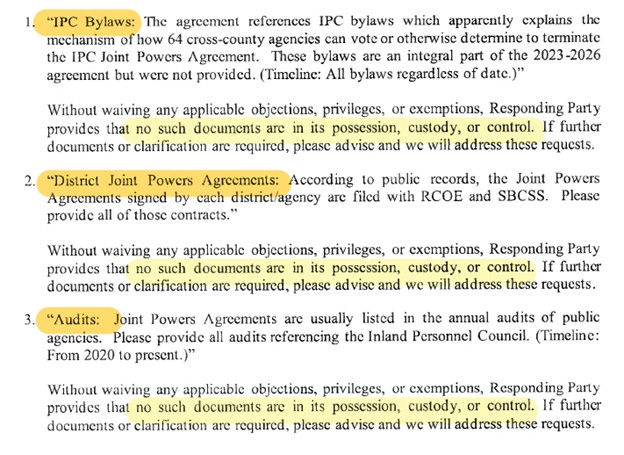
records—such as Advisory Committee agendas,
minutes, and communications—they invoke an
extraordinary range of doctrines, including:
Brown Act “confidentiality”
California and federal constitutional privacy rights
FERPA (student records protections)
Attorney-client privilege
Attorney work product doctrine
Deliberative process privilege
Pending litigation protections
This sweeping approach is striking given the nature of the request, which seeks governance and operational records—not student files or litigation strategy. The result is a troubling picture: IPC’s structure is acknowledged, its activities are confirmed, but the records that would explain how it operates are either claimed not to exist, delayed, or withheld behind an ever-expanding list of legal justifications.
The conflicting positions of the IPC Executive Officers, the absence of foundational governance records, and the excessive reliance on broad legal denials raise serious concerns about transparency—and about where and how public tax dollars are actually being spent.
---------------------------------
Public records posted on social media also reveal an internal email exchange between IPC Director Jeff Malan and Advisory Committee member Danny Polmounter of Hesperia Unified School District regarding the next Advisory Committee meeting.
According to that communication, the meeting is scheduled for April 22 at 1:00 p.m. at The State restaurant
in Riverside. The exchange reflects Mr. Malan’s role in coordinating the Advisory Committee, underscoring his central involvement in organizing and directing IPC activities.
At the same time, the meeting appears to be taking place outside of public view. Members of the public who learned of the meeting from social media posts have requested the agenda for this meeting. Many have expressed their intent to attend and make public comment to the Advisory Committee regarding their concerns about IPC.

To date, no agenda has been publicly posted on the IPC website.
While internal communications show that Advisory Committee meetings are being actively scheduled and coordinated, there is no corresponding public-facing process that would allow for transparency, public participation, or oversight of any kind.
The Advisory Committee Members are listed as: Heather Williams (RCOE), Suzanne Hernandez (SBCSS), Dr. Christi Barrett (Hemet Unified), Dr. Sherry Smith (Alta Loma Unified), Tracy Sepulveda (Lake Elsinore), and Danny Polmounter (Hesperia Unified.) There is no public record of how they were chosen for these roles, or what topics they discuss at these meetings.
The absences of posted agendas raises questions about if the state open meetings law - the Brown Act - is being followed by the County Superintendents and other IPC district members.

Update 5-6-26: The IPC website appears to have been modified to remove the IPC Advisory Committee members page. The website provides no explanation for the removal of the Advisory Committee or why Mr. Alejandre and Mr. Gomez were not pictured with the rest of the Committee. In addition, the Joint Powers Agreement stipulates that a quorum consists of both Executive Officers and one representative. It is unclear whether Mr. Alejandre and Mr. Gomez attended the April 1st meeting which may have been moved to another location after members of the public expressed interest in attending. Those who attended hop reported that no one from the Advisory Committee showed up at the restaurant .
Board Responsibility and Oversight of Contracts, Finances, and Staff
School boards have a fiduciary duty to taxpayers and are responsible for how public money is spent. That includes approving contracts and understanding exactly what they are paying for.
The lack of awareness and understanding of the contractual arrangements with the Inland Personnel Council (IPC) raises serious concerns about whether that oversight is actually occurring—or whether governing boards have ceded that responsibility to county superintendents, district staff, and even vendors involved in providing and administering services funded through public expenditures.
Elected officials represent the public—not employees or vendors—and are entrusted to use public funds wisely and respectfully. Public records showing employees staying at high-end resorts at approximately $350 per night for IPC conferences which include “Attorney Time and Cocktail Hour.” These expenditures deserve closer scrutiny by board members to determine whether public funds are being spent in a manner consistent with appropriate fiscal oversight and public benefit.
School board members cannot claim complete ignorance. IPC membership dues are paid every six months, and IPC is often established as a vendor in district accounting systems, indicating that district staff are aware of these recurring expenditures. If that information has not been clearly communicated to governing boards, it reflects a breakdown in communication—and a failure of board oversight of its employees.
The story of IPC should serve as a wake-up call for governing boards. It raises serious questions about other contracts that may be in effect with potentially unknown ramifications, and other public funds being spent without proper oversight. To restore the public trust, board members need to exercise their oversight authority as elected officials representing members of the public and their hard earned tax dollars.
Questions Boards and Administrators Should Be Asking
Boards must ensure they fully understand the IPC Joint Powers Agreement and the county-level Agreement for Special Services—specifically, whether the transfer of authority to county superintendents exceeds the board’s authority, whether those provisions are enforceable, and whether the arrangement is truly beneficial to their districts and the constituents who ultimately bear the cost.
What are we actually part of? Where are the bylaws, who are the members, and when did this board last review or approve the agreement?
What are we legally bound to? How are districts required to follow a separate services agreement they did not sign—and that can be changed without their approval?
Who controls the terms, decisions, and termination? What authority allows county superintendents to set services, fees, and structure across independent districts—and to influence whether and how districts can exit the agreement?
What are we paying—and where is it recorded? Are IPC costs embedded in legal services billing, and how are those expenditures tracked and approved?
Are we actually saving money? Do any “discounts” outweigh the full cost of participation, including conferences, travel, and related expenses?
----------------------------------------------------------------------------------------------------------------------------------
PART 1 CONTINUED: Behind-the-Scenes IPC Dissolution and “Reorganization” Deepen Transparency Concerns

Comments