

Gwen Dowdy-Rodgers Faces FPPC Investigation as Controversies Surrounding Her San Bernardino County Board Presidency Mount
Updated: 6 days ago
Eight IPC-related Brown Act complaints, an ACLU cease-and-desist letter, law-enforcement reports — and now an anonymous gray seal — mark a year of controversy surrounding County Board President Gwen Dowdy-Rodgers.
San Bernardino County Board of Education President Gwendolyn “Gwen” Dowdy-Rodgers is now under investigation by the California Fair Political Practices Commission (FPPC) over campaign-finance disclosures filed by her candidate-controlled committee.
In a September 23, 2026 letter, the FPPC Enforcement Division stated that it “will investigate the allegations” contained in a sworn complaint involving Dowdy-Rodgers, her campaign committee and longtime treasurer Dolores Armstead. The investigation follows nearly a year of controversy surrounding Dowdy-Rodgers’s leadership, including eight IPC-related Brown Act complaints and an ACLU cease-and-desist letter.
During that same period, Dowdy-Rodgers’s associates and supporters repeatedly accused private citizens of racism and racial targeting — at Board meetings and online — while escalating safety concerns ultimately resulted in multiple law-enforcement reports. As Board president, Dowdy-Rodgers allowed the accusations directed at private citizens during public comment to continue despite Board policies governing public comment and the legal limits on matters properly addressed during that forum.

FPPC Opens Investigation into Dowdy-Rodgers Campaign
At the center of the FPPC complaint are campaign reports in which Dowdy-Rodgers’s committee repeatedly identified contributors’ occupations and employers as “Unknown/Unknown.” Many of those contributors were people within Dowdy-Rodgers’s longstanding governmental, education and professional circles, making the repeated “Unknown” entries particularly difficult to explain.

California campaign-reporting rules require specified identifying information for contributions of $100 or more. If the required information is not obtained within 60 days of receiving the contribution, the contribution must be returned. FPPC recordkeeping regulations require committees to maintain contributor information and records of communications used to obtain missing information.
Dowdy-Rodgers’s July 29, 2026 Form 460 contains the standard verification that “all reasonable diligence” was used in preparing and reviewing the statement and that, to the best of the signers’ knowledge, the information was true and complete. The filing was certified under penalty of perjury, with typed signatures for Dowdy-Rodgers and Armstead.
The July 2026 filing contains 20 individual contributions reported as “Unknown/Unknown,” plus another contribution with the occupation and employer fields left blank is a $100 contribution from campaign Treasurer Dolores Armstead herself — the treasurer responsible for the filing.
The street-address omissions are even more extensive. None of the 46 itemized contribution entries reviewed by EdWatch across the three filings includes a contributor’s street address. Instead, the filings list city, state and ZIP code. That is particularly conspicuous because Schedule A itself expressly labels the required contributor-information field “FULL NAME, STREET ADDRESS AND ZIP CODE OF CONTRIBUTOR.” FPPC guidance likewise identifies the contributor’s full name and street address among the information that must be maintained and itemized for contributions of $100 or more.
FPPC Forms Show “Unknown” Contributors Include State Superintendent Tony Thurmond

Among the contributors identified in the complaint is Tony Thurmond. Thurmond contributed $150 to Dowdy-Rodgers’s campaign in March 2026. His occupation and employer were reported as “Unknown/unknown” despite his prominent role as California’s elected State Superintendent of Public Instruction, who leads the California Department of Education.
Just three months earlier, Dowdy-Rodgers had hosted a political event for Thurmond’s gubernatorial campaign that identified his title on the invitation. Those circumstances raise an obvious question: how could the campaign report Thurmond’s occupation and employer as unknown?

Scott Wyatt, who contributed $200, was reported as “Unknown/Unknonw” [sic]. Wyatt and Dowdy-Rodgers were elected together to the San Bernardino City Unified School District Board in 2015 and served together for 8 years. They also participated together for many years in leadership roles on the San Bernardino Countywide Gangs and Drugs Task Force. (The San Bernardino County Sentinel recently reported on the controversies surrounding the SBC Gangs and Drugs Task Force.)
Wyatt is an SBCSS administrator and remains an elected SBCUSD trustee. Given their decade of working alongside one another, the campaign’s reporting of Wyatt’s occupation and employer as "unknown" similarly raises questions about what information the committee possessed and what efforts were made to obtain it. Edwatch was able to obtain information on Wyatt's employer and occupation within moments.

Other contributors reported as “Unknown/Unknown” included Myrlene Pierre, a longtime SBCSS Assistant Superintendent who frequently makes presentations to the Board of Education on which Dowdy-Rodgers sits, and Barbara Alejandre, a former longtime SBCSS Chief Intergovernmental Relations Officer and wife of County Superintendent Ted Alejandre.
The reporting issue also predates the 2026 filing. In 2023, Dowdy-Rodgers’s committee reported Yvonne Molles, a longtime SBCSS employee who contributed $200, with her occupation and employer listed as “unknown/Unknown.” The complaint documents that Molles had worked for SBCSS for several years and had appeared before the County Board as part of SBCSS Student Services.
The significance of those relationships is now among the factual questions before the FPPC. The investigation will determine whether the campaign’s disclosures complied with California law and, if not, what consequences apply. Those consequences can include administrative fines of up to $5,000 per violation and, where required contributor information was not obtained within 60 days, the return of the contribution. If a contribution cannot be returned, the law requires the money to be paid to the appropriate government general fund.
The 460 filings are provided below.
But campaign-finance compliance is only the newest issue surrounding Dowdy-Rodgers. Questions about her leadership of the County Board had been building for nearly a year.

October 2025: Public Oversight Is Met With Racial Accusations by Dowdy-Rodgers Associates
At the October 13, 2025 Board meeting, Dowdy-Rodgers presided as multiple longtime colleagues, associates and supporters used public comment to criticize citizens who had been appearing before the Board, accusing them of dishonesty, improper motives and racial targeting.
The citizens had been presenting information drawn from lawsuits, public records and other government documents while raising questions about public contracts and expenditures, conflicts of interest, child-safety and mandated-reporting issues, Board policies, Brown Act compliance and the conduct of public officials. The responding speakers did not identify which specific statements were supposedly false or explain how the underlying records were inaccurate. Instead, they broadly dismissed the citizens’ concerns as false, baseless or misinformation and turned their attention to the citizens themselves.
As Board president and presiding officer, Dowdy-Rodgers was responsible for the orderly operation of the meeting and for administering public comment in accordance with applicable law and Board policy. Yet she did not stop or redirect speakers as they questioned the citizens’ motives and character, accused them of racism and directed remarks toward the audience rather than the Board. When objections were raised that the comments violated the Brown Act and the Board’s own public-comment rules, Dowdy-Rodgers rejected those objections and allowed the comments to continue.
The circumstances also created an appearance of favoritism. Many of the speakers were longtime colleagues, associates or supporters of Dowdy-Rodgers who appeared at the same meeting to defend her and County leadership while advancing similar accusations against the citizens questioning them. Their collective appearance raised questions about whether their attendance had been encouraged or organized by someone connected to County leadership. EdWatch has not established that Dowdy-Rodgers solicited their attendance, but her relationships with the speakers — combined with the latitude she gave them from the president’s chair — made the question difficult to ignore.
The individual comments show how quickly scrutiny of government conduct was replaced by scrutiny of the citizens themselves.
A former longtime SBCSS administrator who had worked closely with County education leadership for approximately 25 years characterized the scrutiny as a “political assault” and “witch hunt” intended to “defame, discredit, slander and malign” SBCSS employees, affiliates and leadership.

Keynasia Buffong, a public employee who serves as a Transfer and Career Services Coordinator at San Bernardino Valley College, described the citizens’ concerns as “baseless, recycled claims without evidence,” accused them of spreading misinformation and asked, “Why are we targeting African Americans?” She warned that “we are playing with people’s lives” and stated that public officials were being “dragged through the mud.”
Yet Buffong’s concern about “playing with people’s lives” and dragging people “through the mud” did not appear to extend to the private citizens she had criticized. Buffong — a public employee whose position involves counseling and assisting students — later reacted positively to multiple posts publicly targeting those identifiable private citizens. She liked a post calling them “Karens” and comparing them to the Central Park “Karen” who made a false police report against an African American. In August, she gave a “Love” reaction to another post that displayed their photographs, again called them “Karens,” accused them of “feign[ing] victim status” and falsely claiming to fear Black people, and placed their images alongside a warning that filing a false police report is a crime.
Other speakers invoked “coordinated racial targeting” and “racial profiling.”
Yet the accusations remained focused on the perceived motives, character and racial beliefs of private citizens who had raised concerns about governmental conduct.
Within hours, the personal attacks moved beyond the Boardroom and onto publicly accessible social media. Photographs of the citizens taken during and immediately after the October 13 meeting — including a photograph of one citizen outside in the parking lot — were posted online alongside accusations about their motives and conduct. The posts then drew comments and reactions from an even wider circle of Dowdy-Rodgers’s colleagues, associates and supporters.
…my experience with Gwen Dowdy-Rodgers has been among the most demeaning experiences of my life. In my opinion, she has allowed advocacy about child safety and public accountability to be turned into accusations of racism. Her associates have labeled us “KKK” and “Karens.”…While litigation over the children’s allegations is ongoing, people aligned with her have dismissed my statements as false and racist. The issues I brought forward have been reduced to “complaints,” while the children at the center of them are pushed out of the conversation. This has happened under her watch. -- Antoinette Jensen, Mandated Reporter
Yvonne Molles, an SBCSS principal and longtime educator, was also a repeated participant in the online response. Molles reacted to and commented on multiple posts targeting identifiable private citizens who had spoken at Board meetings. In one instance, she praised a post calling a government critic a “Klueless Karen” that invoked imagery of a Black woman surrounded by masked white supremacists. In other exchanges, Molles described the citizens’ conduct as “Absolutely crazy behavior!!,” called criticism of them “spot on,” accused them of “play[ing] victim” while “bullying,” and called them “Shameful individuals!!”

In August, after another post displayed the citizens’ photographs, called them “Karens” and portrayed their reported safety concerns as claims of being frightened by Black people, Molles praised the poster for “speaking up, standing firm, and refusing to allow fear-based narratives to overshadow the truth.”
Molles’s participation is particularly notable because she is an SBCSS principal, not simply a political supporter. California’s professional standards for educators address ethical conduct, fairness, respectful treatment of others, bullying and racism, and responsible use of social media. Her participation in posts assigning racial motives and derogatory labels to identifiable private citizens therefore raises questions about the professional standards expected of an SBCSS administrator.
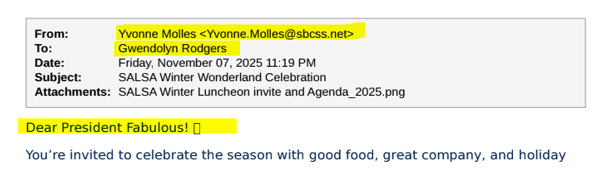
Molles was also a Dowdy-Rodgers campaign contributor whose $200 contribution was reported with her occupation and employer as “unknown/Unknown.” Their familiarity was evident in later public records: in 2025, Molles addressed Dowdy-Rodgers as “Dear President Fabulous!”
And Molles was hardly alone.

Stephani Congdon, who identifies herself as a public-affairs liaison for Learn4Life, a network of public charter schools, was another repeated participant in the online posts. Congdon made multiple comments on the November post calling the private citizens “Karens” who made “baseless accusations,” thanked both Wil Greer and the poster, and gave the post a “Love” reaction. On the December post comparing the citizens to the Central Park “Karen,” Congdon liked the post and commented, “It’s like our president. He can call people names but they can’t speak out against him.” In July, Congdon commented on a post calling one citizen a “Klueless Karen,” portraying her criticism of Dowdy-Rodgers as racial targeting and comparing Dowdy-Rodgers to a young Black woman surrounded by masked white supremacists. Congdon wrote, “Right on Laura. It was difficult even for me to sit through the rhetoric..."

Laura Mancha, a member of the San Bernardino County Board of Education who also works as a Community Services Liaison for San Bernardino County Supervisor Joe Baca Jr., repeatedly participated in the online posts. In October, Mancha liked the post describing the private citizens as “Project 2025 supporters” who were “on the attack” against SBCSS and Board leadership and commented, “It was good to see your friendly faces out there. We need you.”
She later liked the November post praising Wil Greer after he used public comment to confront a private citizen who had questioned a publicly funded consulting contract. Dowdy-Rodgers allowed Greer’s remarks to continue even though they were directed at a private citizen rather than the Board and did not concern a matter within the Board’s jurisdiction.
Mancha also liked the December post comparing the citizens to the Central Park “Karen” after they raised safety concerns and, in July, liked the post calling one citizen a “Klueless Karen,” portraying her criticism of Dowdy-Rodgers as racial targeting and invoking imagery of masked white supremacists.
 |  |

Jonathan Buffong, a Mental Health Education Consultant for the San Bernardino County Department of Behavioral Health’s Office of Equity and Inclusion, was another participant both inside the Board meeting and online. Buffong spoke at the October 13 meeting in support of Dowdy-Rodgers and County Superintendent Ted Alejandre while characterizing the citizens’ accusations as baseless. Afterward, he gave a “Wow” reaction to a post describing the citizens as “Project 2025 supporters” who were “on the attack targeting SBCSS and SBCBOE leadership and staff” and praising those who had appeared at the meeting “to expose them.”
In November, Buffong gave a “Love” reaction to the post praising Wil Greer after Greer used public comment to confront a private citizen who had questioned a publicly funded consulting contract for up to $3000 per hour. The post called the citizens “Karens,” accused them of making “baseless accusations,” “crying wolf” and “playing the victim.” Buffong also commented: “Love it!”
The participation of an elected official raises a distinct concern. Mancha represents the public — including the private citizens being criticized in these posts. She holds governmental authority that those citizens do not. Her participation in posts ridiculing or assigning racial motives to citizens who appeared before the Board therefore raises questions about the responsibilities that accompany elected office and the treatment of constituents who criticize their government.
The participation of government employees raises a different professional and ethical concern. Public employees and administrators are paid with public funds and are subject to the professional and ethical standards governing their positions. When government employees publicly join in personal attacks, ridicule or racial characterizations of identifiable private citizens for questioning public agencies and officials, their comments can harm the reputations of the citizens they target while simultaneously leaving a publicly documented record of their own conduct for their employers and the public to evaluate.
Others discussed increasing their presence at future meetings. One commenter asked, “Do we need to come to next one in great numbers? Just let me know.” The exchanges also celebrated Wil Greer’s subsequent confrontation with one of the citizens at a Board meeting, including the comment, “Get ’em Wil Greer!” Another commented that "These interruptions are from the 'Karens' who are full of the devil." Jonathan Buffong, Keynasia Buffong and others connected to County government and education also participated in the broader online response by continuing to like or comment on the ongoing posts.
The rhetoric continued to escalate. The citizens were associated with imagery invoking white supremacy and angry white mobs, portrayed as racists and extremists, and equated with evil. Comments encouraged the circulation of their photographs and discussed bringing additional people to future meetings where their presence was expected.
Conspicuously absent from the accusations, however, were examples of the supposedly racist statements or actions. The posts and comments reviewed by EdWatch did not identify any specific remarks by the citizens about race or explain what statements supposedly justified the repeated accusations of racism and imagery invoking the KKK, white supremacy and angry white mobs.
Instead, the underlying public comments concerned government matters: IPC, Brown Act compliance, Board policies, child-safety concerns, public contracts, and the potential misuse of public funds. The Board meetings are recorded and publicly available online. Viewers can watch the underlying public comments themselves and decide whether questions about IPC, Brown Act complaints, Board policies, child safety, and the expenditure of public funds support the subsequent accusations of racism and claims that private citizens were targeting African Americans.
November 2025: Questions Turn to Dowdy-Rodgers’s Leadership
By November, the issue was no longer simply what Dowdy-Rodgers’s supporters were saying. It was how Dowdy-Rodgers was responding as Board president when members of the public became the target in the forum she presided over.
As EdWatch previously reported, longtime Dowdy-Rodgers associate Wil Greer confronted a citizen who had questioned a consulting contract between SBCSS and Sherman Garnett Sr., a former SBCSS employee and County Board of Education member, that equated to approximately $3,000 per hour according the San Bernardino Sentinel.
Greer acknowledged that he had not reviewed the SBCSS/Garnett Sr. contract at issue, but asked, “Who are you to question?” and told the citizen to “please kindly sit down and do not come up here again.”

Dowdy-Rodgers did not redirect Greer. Instead, she admonished audience members who objected and later redirected another speaker who raised a safety concern about the confrontation.
The full incident was previously reported by EdWatch. But an even larger governance issue was about to emerge.
A Pattern Emerges: Dowdy-Rodgers Keeps Key Matters From the Full Board
In December, public-records research uncovered the Inland Personnel Council, or IPC, a multi-county arrangement that had operated for more than 40 years involving public education agencies in San Bernardino and Riverside counties. EdWatch has reported extensively on IPC, its use of public funds, relationship with AALRR and unresolved questions surrounding its purported discontinuation.
For Dowdy-Rodgers’s leadership, the central issue was simpler: she refused to place IPC on the agenda for consideration by the full Board.
Without an agenda item, the five elected Board members could not collectively deliberate or act on IPC. Brown Act complaints followed. By September 2026, eight IPC-related complaints had been submitted but remained unaddressed by the Board as the legislative body.
And this was not the first time a Brown Act complaint directed to the County Board failed to reach the full elected Board.
A recently published San Bernardino County Sentinel investigation identifies an earlier Brown Act complaint that followed a strikingly similar path. According to the Sentinel, an August 2025 Brown Act cure-and-correct demand concerning the San Bernardino Countywide Gangs & Drugs Task Force was submitted to Board President Dowdy-Rodgers and County Superintendent Ted Alejandre. Dowdy-Rodgers was also serving as chair of the Task Force. Rather than bringing the complaint before the five-member County Board for consideration, SBCSS Communications and Intergovernmental Relations Director Jenny Owen responded that the Task Force was not subject to the Brown Act and declared the matter concluded. The five elected Board members were never given the opportunity to consider the complaint.
The circumstances foreshadowed what later occurred with IPC: Brown Act complaints concerning organizations connected to SBCSS were directed to the County Board, yet the full elected Board was never given the opportunity to consider them.
Board Policy 113 provides a process for Board members to request future agenda items and ultimately allows the full Board to decide whether a requested matter should be heard. Yet IPC and the related complaints remained outside consideration by all five elected members.
February 2026: The ACLU Warns Dowdy-Rodgers and the Board
By February, concerns about the Board’s treatment of public speakers had drawn outside intervention.
On February 2, the ACLU sent a formal cease-and-desist letter to Dowdy-Rodgers and the Board challenging its requirement that public speakers identify themselves. The ACLU asserted that the requirement violated the Brown Act and First Amendment, warned that forced identification could chill participation by people concerned about retaliation or harassment, and demanded that the Board change its policy or potentially face litigation.

Dowdy-Rodgers never brought the ACLU’s demand before the full Board for consideration. It was another significant matter directed to the elected Board that its five members were never given the opportunity to consider.
She later acknowledged that the speaker-identification policy needed to change without publicly identifying the ACLU intervention, leaving Board members without an opportunity to consider or discuss the cease-and-desist demand and the public unaware that the ACLU had challenged the Board’s policy in the first place.
The ACLU’s warning about retaliation and harassment became increasingly relevant as identifiable photographs of private citizens questioning government conduct continued appearing online alongside personal attacks and accusations of racism and racial targeting.
Months later, an anonymous speaker would turn the controversy into political satire with two words:
“IDENTITY SEALED.”
Online Targeting and In-Person Conduct Raise Safety Concerns
Meanwhile, the treatment of private citizens continued to escalate — online and inside the meetings Dowdy-Rodgers presided over.
The person at the center of the concerns was not a stranger to County education leadership. A former longtime SBCSS employee who had worked closely with County leadership for approximately two decades repeatedly attended meetings, focused attention on two private citizens raising governmental concerns, photographed them while they spoke, stayed positioned nearby or behind them and published identifiable photographs online alongside hostile and racial commentary. Because the posts were public, the ultimate audience was unknown.
The social media posts also drew commentary from multiple people associated with Dowdy-Rodgers, including Brenda Dowdy, a former longtime SBCSS employee and Gwen Dowdy-Rodgers’s sister.
The circumstances inside the meeting room heightened those concerns. After the room configuration was changed, speakers addressed Dowdy-Rodgers and the Board with their backs to the audience, leaving them unable to see who was approaching from behind. Police reports described the photographing becoming progressively closer, along with monitoring or following after meetings and rapid online publication of the citizens’ images.
The former employee was well known to both Dowdy-Rodgers and County Superintendent Ted Alejandre, with numerous photographs and other evidence of those relationships publicly available. Meanwhile, Dowdy-Rodgers and SBCSS controlled the meeting environment, including the room configuration, placement of the public-comment podium and security.
The citizens repeatedly notified the Board and SBCSS of their concerns and requested additional security but reported receiving no response. With no visible security personnel or screening, they eventually brought another person specifically to watch the audience while they spoke and obtained the facility’s evacuation routes themselves. Multiple reports were ultimately filed with the San Bernardino Police Department documenting allegations of photographing, monitoring, following, public identification and online targeting, along with concerns for physical safety. The concerns also reached the San Bernardino County District Attorney, FBI and U.S. Department of Justice, with requests that federal authorities examine whether the conduct could constitute intimidation or interference with the citizens’ exercise of First Amendment rights.
“I believe there is a clear pattern of Gwen Dowdy-Rodgers ignoring policies and the law, even as private citizens are being harmed. Her actions show disregard for the public and even her fellow Board members. That is not leadership. It is self-interest to the point of absurdity.” — Name withheld for fear of retaliation
An Anonymous Seal Puts the Government Issues Back in Focus
By the September 2026 Board meeting, months of legal complaints, records disputes, personal attacks and safety concerns had produced an increasingly unusual atmosphere.
As Dowdy-Rodgers read the public-comment cards, one name stood out: “Identity Sealed.”
An interpreter was also identified. When Dowdy-Rodgers reached the card, she called, “Identity Sealed, are you here?”
Antoinette Jensen, wearing a “VOTE JENSEN for Alta Loma School District Board Area 5” shirt, escorted an unidentified person dressed as a seal to the podium.
The gray seal — with its large feet, flipper-like mitts and oversized smiling head — wore a tank top bearing the words:
“IDENTITY SEALED.”

The anonymity served a purpose. Months earlier, the ACLU had warned Dowdy-Rodgers and the Board that requiring speakers to identify themselves could chill public participation because of concerns about retaliation or harassment. Since then, identifiable photographs of private citizens speaking at Board meetings had repeatedly appeared online alongside personal attacks, racial accusations and imagery invoking the KKK and white supremacy.
This time, the person inside the seal remained unidentified. Even race had been removed from the equation. To Dowdy-Rodgers, the Board and the audience, the speaker was simply a gray seal.
The room was eerily silent.
The Seal’s Message Was Crystallized in a Few Phrases
The costume was comedic. The signs were not.

“8TH IPC BROWN ACT” referred to the eight IPC-related Brown Act complaints submitted while questions surrounding the Inland Personnel Council remained outside consideration by the full Board.
“NO DICTATORS” challenged the concentration of decision-making authority under Dowdy-Rodgers’s presidency. Board Policy 113 provides a process through which agenda requests can ultimately be considered by the full Board, yet IPC and the related complaints remained outside collective deliberation.
“UNSEAL THE RECORDS” returned the focus to transparency and the public records underlying the controversy.
“IPC IS NOT DEAD; IT AUTO-RENEWED” pointed to a still-unresolved issue in the records. A separate AALRR contract for IPC-related legal services contained an automatic-renewal provision, raising questions about what exactly had been discontinued, who had authority to discontinue it and what records documented that action.
 |  |  |
Other signs declared: “THE TRUTH WILL BE UNSEALED.”
And: “THE CLOCK IS TICKING.”
Reduced to their substance, the messages were straightforward: follow the law, produce the records, address the complaints and allow the elected Board to deliberate.
|  |
The Seal Becomes a Target for Dowdy-Rodgers’s Associates
Photographs of the seal nevertheless appeared online after the meeting, posted by Dowdy-Rodgers’s associates. The resulting discussion was revealing for what it addressed — and what it did not.
The post described the citizens as “Karens” who had “opted for theatrics,” drawing laughing and “wow” reactions. One commenter described the appearance as “crazy.” Another asked, “Why do they allow mentally ill ppl to do this????!!!! What message are we giving our scholars that it is OK to act a fool???”
Dowdy-Rodgers’s sister, Brenda Dowdy, who had also participated in earlier online discussions involving the private citizens, wrote: “This is a shame that they spend time putting on a show rather than solving issues for our students. This is clearly not about the kids.”
But private citizens do not run the County Board of Education. They cannot place items on its agenda, direct staff, adopt policy, authorize expenditures, investigate misconduct or correct the governmental practices they are questioning. Those responsibilities belong to the public officials entrusted with the institution.
Private citizens can ask questions, request records, identify potential problems and bring those concerns to officials with the authority to address them. Yet when these citizens did precisely that, the response repeatedly shifted away from the substance of their concerns and toward accusations about the citizens themselves.
SBCSS administrator and Dowdy-Rodgers campaign contributor Yvonne Molles described the conduct as “immature adult behavior” and referred to “adults who need to get a life and only purpose is to create division vs focusing on the work of our county.” County Board member Laura Mancha and Molles both liked the comment questioning why “mentally ill ppl” were allowed to participate. Molles also reacted to other comments in the discussion.
The underlying public comments, however, concerned government matters: IPC, Brown Act compliance, Board policies, child safety, public contracts and the potential misuse of public funds. The meetings are recorded and publicly available online, so viewers can watch the comments and judge the accusations for themselves.
There is another contradiction. If the accusations were true, and speakers really were making racially targeted comments unrelated to matters within the Board’s jurisdiction, then it was Dowdy-Rodgers’s responsibility as Board president to address them during the meetings.
The logic leaves two possibilities: either the accusations against the private citizens are unsupported or, ironically, if these actions did take place, Rodgers’s own supporters are pointing to repeated failures by her to perform her responsibilities as Board president — the same failure to govern that the citizens had been raising.
But amid the criticism came an unexpected question. Another commenter addressed Molles directly:
“no one felt uncomfortable or believed a person in a costume created a safety issue? Quite unacceptable...Security?”
No response from Molles appears in the thread.
The question was particularly striking given what had preceded it. For months, the private citizens had repeatedly asked Dowdy-Rodgers and SBCSS for additional security after reporting that they were being monitored, followed and repeatedly photographed at meetings, with their photographs subsequently appearing online alongside racially charged imagery and commentary. Those concerns ultimately became the subject of multiple law-enforcement reports.
Now, someone participating in the same online discussion was raising a security concern too — because of the seal.
What the Seal Changed — and What It Didn’t
In some respects, the seal accomplished exactly what it was intended to do.
By concealing the speaker’s identity — and race — it removed race from the presentation itself. The online response from Dowdy-Rodgers’s associates and allies also took on a noticeably different tone. Instead of imagery invoking white supremacy, the KKK, evil and racial hostility, the reaction included laughing and “wow” responses to the absurdity of an anonymous gray seal standing before the Board.
It even produced an unexpected point of agreement: safety.
After months in which the private citizens had asked Dowdy-Rodgers and SBCSS for additional security, someone in the online discussion finally questioned the lack of security too — this time because of the costume.
But one thing did not change.
The discussion still ignored the message. There was no visible engagement with the eighth IPC-related Brown Act complaint, “UNSEAL THE RECORDS,” the unresolved questions surrounding IPC, or the criticism of how Board authority was being exercised. Instead, the comments characterized the citizens as “Karens,” “crazy,” “immature,” divisive and “mentally ill.”
That echoed October 2025, when many members of the same circle characterized the private citizens as engaging in racial targeting. Months later, even with the speaker’s race literally hidden from view and the government concerns written in large letters on poster boards, the response again centered on the citizens’ character, motives and beliefs rather than the issues they raised.
The seal had worked — but perhaps not in the way anyone expected. It removed the speaker’s race from view, changed the tone and even produced common ground on the need for security. But it also exposed something else: even when the citizens’ actual concerns were written in large letters directly in front of them, this group of Dowdy-Rodgers associates focused on the people raising them while the message itself remained virtually invisible.
What Comes Next for Dowdy-Rodgers and the Board?
For nearly a year, the controversies surrounding Dowdy-Rodgers’s presidency have shared an increasingly clear thread: information that should have been available for public scrutiny repeatedly failed to reach the public or the full elected Board.
A Brown Act cure-and-correct demand involving the Gangs & Drugs Task Force was directed to Dowdy-Rodgers and County Superintendent Ted Alejandre, but the five elected Board members were never given the opportunity to consider it. IPC was kept off the agenda, preventing the full Board from deliberating on it, while eight related Brown Act complaints accumulated without full-Board consideration. When the ACLU sent Dowdy-Rodgers and the Board a cease-and-desist letter challenging the Board’s speaker-identification policy, that letter likewise was never brought before the full Board — and the public was not told that the ACLU had intervened.
The result was the same each time: significant legal challenges involving the County Board remained outside the public Boardroom where they could have been disclosed, discussed and addressed by all five elected members.
Now a similar transparency question has emerged in Dowdy-Rodgers’s own campaign filings.
California campaign-disclosure laws exist so the public can see who is financially supporting candidates and obtain required identifying information about those contributors. Yet Dowdy-Rodgers’s filings repeatedly reported the occupations and employers of contributors as “Unknown” — including longtime associates and public officials whose occupations were publicly identifiable — while contributor street addresses were omitted throughout the filings reviewed by EdWatch. Her campaign treasurer’s own $100 contribution contained no occupation or employer information at all.
Whether those campaign disclosures violated California law is now for the FPPC to determine. But viewed alongside the governance issues surrounding Dowdy-Rodgers’s presidency, they add another dimension to the same transparency question: Why does information the public is entitled to scrutinize so often appear to stop short of the public record?
By September, an anonymous gray seal was standing before the Board carrying signs demanding records, Brown Act compliance and full-Board deliberation.
One declared:
“THE TRUTH WILL BE UNSEALED.”
With Dowdy-Rodgers’s campaign filings now under FPPC investigation, that message has taken on an unexpected relevance.
After nearly a year of questions regarding transparency, Board governance and accountability, two questions now rest squarely with Gwen Dowdy-Rodgers:
Will she finally unseal the answers the public has been seeking? And will she follow the policies and laws she was elected to uphold?
 |

Comments