

PART 1 CONTINUED: Behind-the-Scenes IPC Dissolution and “Reorganization” Deepen Transparency Concerns
Updated: Jun 1
This article is a continuation of Part 1 examining the governance structure and operations of the Inland Personnel Council (“IPC”), including newly surfaced records relating to IPC’s apparent dissolution, restructuring, and relationship with the private law firm Atkinson, Andelson, Loya, Ruud & Romo (“AALRR”). As this is a fast-moving story, updates will be provided below.
UPDATE 5-23-26: Riverside USD Board Publicly Questions IPC Auto-Renewal Structure as District Records Reveal Extensive Internal IPC Activity
UPDATE 5-30-26: Jeff Malan, AALRR Consultant, Blames Public Scrutiny for IPC's Demise, Claims the Private Law Firm is Restructuring the 64-Agency Joint Powers Agreement
The sudden dissolution and restructuring of the Inland Personnel Council (“IPC”) appears to confirm longstanding concerns that decisions involving this 64-public-agency Joint Powers Agreement were being made outside public view and heavily influenced by the private law firm providing services to the structure.
For months, members of the public have raised concerns regarding IPC’s governance structure, automatic renewal provisions, legal-services agreements, lack of public meetings, and the operational role of the private law firm Atkinson, Andelson, Loya, Ruud & Romo (“AALRR”). Multiple Brown Act complaints were also reportedly filed regarding the failure to publicly agendize or discuss IPC despite its apparent operational connection to dozens of public agencies across Riverside and San Bernardino Counties.
These concerns have also expanded beyond local board meetings. Requests for review regarding IPC’s structure, governance, financial arrangements, and transparency issues have reportedly been submitted to multiple District Attorneys as well as the California Attorney General.
It was amid that increasing scrutiny that IPC’s apparent dissolution and restructuring suddenly surfaced — not through publicly agendized board discussions, but through incidental comments made during separate public meetings.
Those comments ultimately led to the discovery of a May 7, 2026 “reorganization” letter distributed by Jeff Malan, who publicly operates under the title of “IPC Director” despite serving as a consultant to AALRR, as previously acknowledged in correspondence from SBCSS spokesperson Jenny Owen.
The letter did not identify any publicly agendized vote, member approval process, or formal board action authorizing either the dissolution or the proposed continuation of services through a replacement framework.
San Bernardino County Board of Education
The discontinuation of IPC first came to light during a brief exchange at the May 11, 2026 San Bernardino County Board of Education meeting. Board member Rita Fernandez-Loof questioned Jessica Hurst, Director of Internal Business Services for the San Bernardino County Superintendent of Schools (“SBCSS”), regarding whether IPC would continue in the budget.
Ms. Hurst confirmed that a $3,000 IPC membership fee had appeared in the prior budget in April but stated that IPC would no longer appear because it had been discontinued. Ms. Hurst also appeared to distance SBCSS from IPC, stating:
“the council was not a JPA of SBCSS. So, we were not the administrative unit for that program.”
This exchange took many members of the public by surprise because IPC had never been meaningfully agendized or publicly discussed by the County Board despite repeated Brown Act complaints and Superintendent Ted Alejandre’s role as one of IPC’s Executive Officers.
That lack of transparency is particularly significant because the County Board serves as the oversight body for SBCSS and Superintendent Alejandre. Yet despite IPC’s apparent operational connection to SBCSS, recurring budget activity, and Alejandre’s Executive Officer role, the structure had remained largely outside public discussion.
The exchange also raised additional concerns because the foundational IPC agreements identify IPC as a Joint Powers Agreement involving Alejandre and Riverside County Superintendent Edwin Gomez as Executive Officers. Questions have therefore arisen regarding Ms. Hurst’s statement that IPC was “not a JPA of SBCSS,” particularly given SBCSS’s apparent operational and financial involvement in the structure.
The discussion also raised financial questions. Ms. Hurst referenced a $3,000 IPC membership installment despite earlier IPC service agreements by Alejandre and Gomez capping large-district installments at $2,500.
The discrepancy has prompted additional scrutiny regarding how IPC dues were assessed, processed, and tracked through public-agency budgets.
Most notably, the correspondence referenced during the meeting about the "discontinuation" of IPC was not provided to the public, nor was IPC formally agendized for discussion despite the significance of the apparent dissolution of a decades-old regional structure involving approximately 64 public agencies. The lack of transparency is further illustrated by the San Bernardino County Board of Education’s apparent failure to publicly respond to at least four Brown Act complaints concerning IPC.
Redlands Unified School District
Separate concerns surfaced the following evening during the May 12, 2026 Redlands Unified School District board meeting.
Board member Candy Olson publicly referenced correspondence indicating that IPC had been discontinued, but also suggested that discussions were already underway to bring IPC back in another form.
That statement suggests IPC’s dissolution, restructuring, and continuation were already being operationally discussed before any publicly visible regional board process appears to have occurred across participating agencies.
Ms. Olson further stated that Redlands board members “didn’t know” about IPC, were unaware the agreement had been automatically renewing since approximately 2012, and only became aware of the structure because of concerns raised publicly.
She additionally stated that IPC-related payments were not readily visible through ordinary board invoice review processes and that district staff had to search historical records to locate the joint powers agreement.
Those comments corroborate broader concerns that governing boards may not have fully understood the IPC structure, that the automatic renewal mechanisms operated with limited board awareness, and that recurring expenditures associated with IPC were not meaningfully visible or scrutinized by elected officials over many years.
Ms. Olson also publicly expressed concern regarding IPC language authorizing districts to seek and share “employee-employer advice” regarding confidential HR matters within the IPC structure. She stated that such language was “very concerning” and questioned why confidential employee matters would be discussed within a regional structure involving multiple districts.
Those comments are particularly significant because they reflect concerns raised independently by an elected governing board member rather than solely by members of the public.
The Correspondence Was Never Publicly Released
The correspondence referenced by Fernandez-Loof and Olson was not provided to the public during either meeting. Copies of the correspondence and related records later surfaced through additional public-records requests and were subsequently obtained by EdWatch.net.
The correspondence appears to confirm that the decision to dissolve and restructure IPC was being operationally communicated not through publicly agendized board actions, but through communications circulated by a consultant to AALRR, the private law firm providing services through the IPC structure.
That has intensified public concerns regarding whether the democratic process surrounding IPC had effectively been inverted, allowing a private law firm to exert substantial influence over the restructuring of an agreement involving approximately 64 independent public agencies governed by locally elected officials.
Correspondence Announcing IPC’s Dissolution Raises Additional Transparency Concerns
The correspondence referenced by Fernandez-Loof and Olson appears to consist of an email with several attachments sent by Jeff Malan, who identified himself in the correspondence as “Director, Inland Personnel Council” while not disclosing his consulting relationship with AALRR.
The email titled: “Inland Personnel Council Announcement – Reorganization” was distributed to Alejandre and Gomez, along with certain district superintendents and human-resources administrators, on May 7, 2026.

The timing of the correspondence raises additional questions. The “reorganization” letter was distributed shortly after the IPC Advisory Committee was removed from the IPC website, and the day after the abrupt cancellation of the May 8, 2026 IPC General Meeting.
Those developments appeared to occur rapidly and largely outside public view despite IPC’s involvement with approximately 64 public agencies across Riverside and San Bernardino Counties.
Yet neither the email nor the attached correspondence appears to identify any public meeting, vote, agenda item, or formal approval process authorizing the dissolution and restructuring of IPC.
According to the Joint Powers Agreements signed by participating districts, individual agencies may withdraw from IPC only through formal board action and written notice to the Executive Officers by specified deadlines. Likewise, the county-level Agreement for Special Services states that termination requires written verification that a majority of IPC member governing boards elected to terminate the agreement pursuant to procedures supposedly established in the IPC bylaws. Yet the available bylaws do not appear to establish any such regional termination procedures.
The May 7 correspondence does not identify that any such regional governing-board process occurred, nor does it explain what authority or procedure was relied upon to declare IPC ‘discontinued.
The email also copied multiple AALRR attorneys, including Mark Thompson, who reportedly signed the 2020 and 2023 IPC Agreements for Special Services and addendums on behalf of AALRR, and Todd Robbins, an attorney publicly associated with IPC-related presentations and programming. Their inclusion further reinforces concerns regarding the deeply intertwined operational relationship between IPC and the private law firm providing legal and labor-relations services through the IPC structure.
The correspondence and attached materials appear to show AALRR exercising substantial influence over the dissolution and resurrection of a Joint Powers Agreement involving dozens of public agencies — actions occurring largely outside public view.
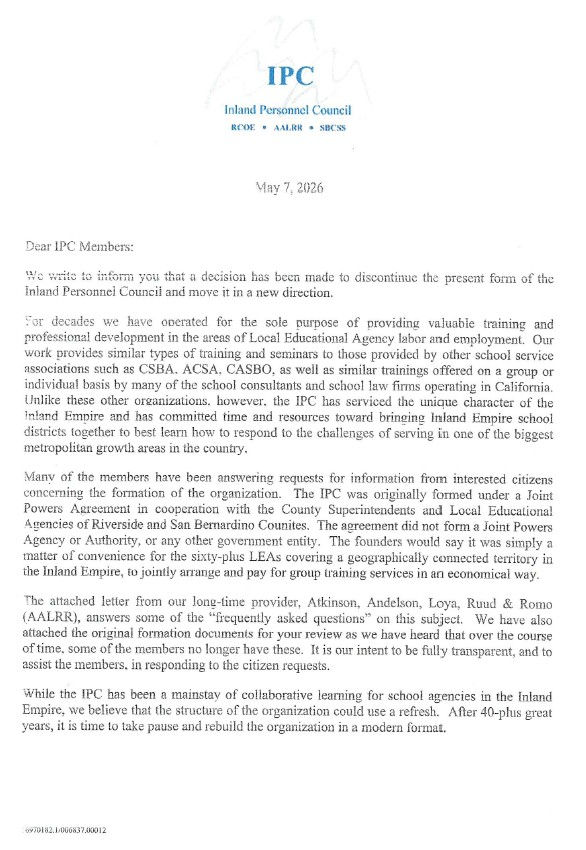
The May 7 correspondence utilzes the IPC logo appearing to depict IPC as RCOE, AALRR and SBCSS. The letter also appears to contain an internal law-firm-style document control or matter-reference number in the footer. Because IPC was not structured as an independent entity, additional questions arise regarding who authorized, funded, or potentially paid for the drafting and distribution of the IPC "restructuring" communications.
When viewed through the lens of AALRR being a private law firm, and Jeff Malan being a paid consultant to that firm, the situation raises additional governance and transparency concerns.
The structure described in the letter appears backwards from ordinary public-agency governance. Only public agencies — acting through their governing boards — can determine whether to participate in governmental structures such
as a Joint Powers Agreement.
AALRR was the vendor selected by the Executive Officers to provide services through the IPC structure, but a private for-profit law firm cannot function as a governmental partner or decision-maker within the structure itself.
Yet the records appear to show that the law firm played a significant role in the transition process, announcing the restructuring and positioning itself to continue substantially similar services afterward.
The Language of the May 7 Letter Conflicts With IPC’s Governing Documents
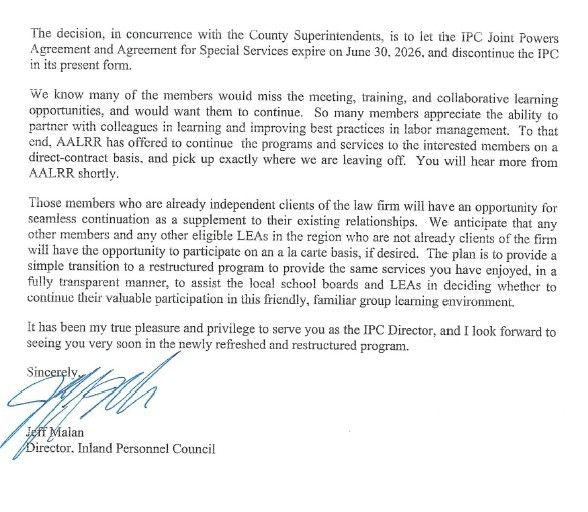
The May 7 letter repeatedly uses collective language such as “we write,” “our work,” and “our long-time partner,” while never clearly disclosing that Mr. Malan serves as a paid consultant to AALRR.
The purpose of the letter is likewise unclear. Malan states that:
“a decision has been made to discontinue the present form of the Inland Personnel Council and move it in a new direction.”
But he never identifies who made that decision, when it was authorized publicly, or why the decision was made at all.
Malan then provides background regarding IPC that conflicts with the governing documents themselves. He states that IPC operated “for the sole purpose of providing valuable training and professional development in the areas of Local Educational Agency labor and employment.”
That characterization directly conflicts with the 1984 Joint Powers Agreement, which expressly states that IPC was formed to provide shared legal services and legal advice — not merely training.
Malan later compares IPC to organizations such as CSBA, ACSA, and CASBO, which are private professional associations, before acknowledging that IPC operated “in cooperation with the county Superintendents and Local educational Agencies of Riverside and San Bernardino Counties.” He then again minimizes the structure by characterizing IPC as a way to jointly “pay for group training services in an economical way.”
But the governing documents do not describe a training consortium. From its inception, IPC was structured through a Joint Powers Agreement governed by Government Code section 6500 et seq., complete with Executive Officers, bylaws, Advisory Committees, Agreements for Special Services, and mechanisms for the administration and transfer of public funds.
Malan then references an attached letter “from our long-time provider,” AALRR. The wording makes Malan appear to be speaking on behalf of the districts themselves rather than as a paid consultant for the law firm.
Foundational IPC Records Remained Publicly Unavailable Despite AALRR Possessing Them
Malan further states that “we have also attached” the original foundational documents.
That statement raises additional concerns because many public agencies reportedly did not possess those records, and some board members publicly stated they did not even know their districts were participating in IPC.
Governance documents, operational materials, and bylaws do not appear to have been readily publicly available. In at least one response to a request for public records, Riverside County Office of Education and Superintendent Edwin Gomez reportedly stated they did not possess the IPC bylaws, despite the bylaws being repeatedly referenced throughout the governing agreements.
Malan’s assertion that IPC intended to operate with “full transparency” is therefore difficult to square with the surrounding circumstances. The May 7 letter was reportedly distributed to county superintendents and district employees — not to governing boards or the public — and the purpose of the dissolution and restructuring was never meaningfully explained.
Of additional concern is the letter’s statement that: “The decision, in concurrence with the County Superintendents” was to allow the IPC Joint Powers Agreement and Agreement for Special Services to expire on June 30, 2026.
But the Joint Powers Agreements themselves do not simply expire on June 30, 2026. The agreements explicitly contain automatic-renewal provisions requiring board action and formal withdrawal procedures. Likewise, the county-level Agreement for Special Services renews automatically each fiscal year unless terminated through written notice verifying that a majority of IPC member governing boards elected to terminate the agreement pursuant to the IPC bylaws.
Thus, the contention that AALRR and the two County Superintendents could simply decide to discontinue IPC appears inconsistent with the governing contracts themselves, which require formal withdrawal procedures and written verification that a majority of the approximately 64 participating governing boards voted to terminate the agreement pursuant to the IPC bylaws. If no such governing-board process occurred, it remains unclear on what authority the IPC structure could simply be declared discontinued absent a determination that the underlying agreements or renewal provisions were unenforceable or otherwise invalid.
A “Refresh” Without Public Approval
Malan further contends that many members would miss IPC’s “meeting, training and collaborative opportunities” and would want the services to continue.
But the dissolution of IPC — and any proposed resurrection — does not appear to have been openly discussed or approved by the participating governing boards.
Instead, Malan, acting as a consultant to the law firm, appears to assume both that the services remain necessary and that AALRR should continue providing them.
He then explains that the services will continue on a “direct-contract basis” and “pick up exactly where we are leaving off.”
That statement is especially significant.
Public agencies are permitted to hire vendors they believe serve a legitimate public purpose. But here, the vendor itself appears to be assuming the continued need for the services, framing the replacement structure, and positioning itself as the continuing provider — all before any publicly visible approval process involving the participating boards.
The letter also states that IPC’s structure could use a “refresh” after approximately 46 years, yet it never identifies what governance, legal, financial, transparency, or operational concerns allegedly required dismantling and restructuring the framework.
That omission is especially notable given that the restructuring discussions surfaced amid escalating public scrutiny, Brown Act complaints, and requests for review submitted to multiple District Attorneys and the California Attorney General.
If the growing complaints and oversight requests in fact prompted the sudden “refresh” and restructuring effort, the public has not been told so.
AALRR Was Already Positioned to Continue
The most direct example of the vendor-driven nature of the transition appears in the letter’s statements that:
“AALRR has offered to continue the programs and services...”
and:
“You will hear more from AALRR shortly.”
Those statements make the restructuring appear less like a public-agency governance reform and more like a vendor-managed transition structured to preserve continuity of services through the same law firm.
Instead, the records suggest that the same vendor deeply embedded within IPC operations was already positioning itself to continue substantially similar services through a replacement structure. Rather than resolving concerns surrounding IPC, the May 7 letter appears to deepen them.
The “IPC Director” Problem
The records also raise significant concerns regarding the later appearance of an “IPC Director” position.
The governing documents do not establish or mention any independent “Director” position within either the original Joint Powers Agreement or the IPC bylaws.
Yet the IPC website later stated:
“IPC employs a part time Director.”
That representation appears fundamentally inconsistent with the governing structure itself.
As repeatedly emphasized in both the governing agreements and the later March 20 attorney letter, IPC was not created as a separate governmental entity or Joint Powers Authority. Rather, IPC was structured as an agreement among participating public agencies governed under Government Code section 6500 et seq.
An agreement itself cannot independently hire employees. Thus, the website representation that IPC itself “employs” a Director appears contradictory to the governing documents.
The records instead indicate that Jeff Malan serves as a consultant to AALRR, the private law firm providing services associated with IPC, while publicly operating under the title of “IPC Director.”
That distinction is significant because it further blurs the line between IPC as a governmental agreement among public agencies and AALRR as the private vendor providing services through the structure.
It also raises additional questions regarding when the “Director” position was created, who authorized the title, who supervised the role, under what authority it operated, and through what funding mechanism it was maintained.
Those concerns become even more significant given that Mr. Malan simultaneously communicated with public officials regarding IPC’s dissolution, restructuring, and continuation of services while serving as a consultant to the same private law firm positioned to continue providing those services afterward.
AALRR’s March 20 Letter in Defense of IPC
The governance concerns surrounding IPC became even more pronounced after additional correspondence surfaced from AALRR itself.
Nearly two months before IPC’s dissolution was publicly discussed during board meetings, four AALRR attorneys issued a March 20, 2026 letter defending IPC following increasing public scrutiny regarding the structure’s operations and governance.
The letter referenced:
“bold misstatements of fact fueled by wild speculation.”
Yet the attorneys never actually identified the supposed “misstatements,” quoted any allegedly false statements, or explained which public concerns they believed were unfounded.
The March 20 letter framed the growing public concerns regarding IPC as “wild speculation” and “bold
misstatements of fact,” while characterizing criticism as alleging that IPC operated as a “shadow” entity controlling school-district operations and decision-making.
But many of the concerns raised publicly involved far more specific issues, including IPC’s governance structure, automatic-renewal provisions, evolving legal-services agreements, public-fund administration, transparency practices, Executive Officer authority, and the increasingly intertwined operational relationship between IPC and AALRR.
Instead, the accusations remained vague and generalized.
The timing strongly suggests the letter written by AALRR attorneys was responding to growing scrutiny following the March 14, 2026 San Bernardino County Sentinel article titled “Shadow Government In Your Schools: How A Secretive Two-County Legal Consortium Seized Control of Personnel Decisions Affecting 64 School Districts Without Public Knowledge or Board Approval” But rather than publicly addressing those concerns through openly agendized board discussions, the AALRR attorney response instead appears to have circulated privately among administrators and human-resources personnel.
It does not appear that the March 20 letter was ever publicly discussed. The correspondence surfaced only later in connection with the May 7 dissolution and “reorganization” communications after additional public-records requests were submitted.
Similarly, the foundational IPC governance documents do not appear to have been meaningfully discussed during public board meetings, and according to members of the public, key governance records — including IPC bylaws — had also not been produced in response to prior public-records requests.
As a result, the public did not learn about the attorney response, the behind-the-scenes restructuring discussions, or even the existence of certain foundational IPC governance records through any transparent public-board process.
The manner in which these records surfaced further illustrates the opacity surrounding IPC’s governance and restructuring.
The Attorneys Behind the Letter Have Overlapping Roles
The March 20 letter was signed by four AALRR attorneys directly tied to IPC-related operations and presentations, including Mark Thompson, William Diedrich, Todd Robbins, and Anthony DeMarco.
Mark Thompson reportedly signed the 2020 and 2023 IPC Agreements for Special Services and addendums on behalf of AALRR. Thompson also represented Redlands Unified School District in the California Attorney General matter that resulted in a stipulated judgment requiring multi-year monitoring and compliance measures following the Attorney General’s investigation into the district.
William Diedrich is publicly identified by AALRR as the “collective bargaining trainer for the Inland Personnel Council,” while Todd Robbins is identified as an IPC presenter and participant in IPC programming.
The letter was additionally signed by Anthony DeMarco, an AALRR attorney publicly identified as representing multiple school districts. Yet here, DeMarco was simultaneously signing a letter defending IPC itself and responding to criticism regarding the structure’s governance and operations.
That overlap is significant.
These were not outside commentators misunderstanding the structure. They were attorneys actively advising school districts, drafting agreements, providing legal services through IPC, and signing the very contracts now being publicly characterized as something far more limited than the governing documents describe.
The March 20 letter therefore further blurs the distinction between AALRR acting as outside legal counsel for individual districts and AALRR acting institutionally in defense of the IPC structure itself.
That makes the representations in the March 20 letter especially significant.
Claim: “IPC Has Not Conducted Any Governmental Activity”
One of the most striking claims in the March 20 letter is the assertion that:
“The IPC has not conducted any governmental activity.”
That assertion directly conflicts with the governing documents themselves.
A Joint Powers Agreement is, by definition, a governmental activity. It is a statutory mechanism through which public agencies jointly exercise powers, establish governance procedures, administer shared operations, and transfer public funds under Government Code section 6500 et seq.
The original Joint Powers Agreement expressly invokes Government Code section 6500 et seq., along with multiple Government and Education Code provisions authorizing public agencies to jointly conduct governmental activities and contract for legal services.
The agreements also establish Executive Officers, an Advisory Committee, bylaws, quorum requirements, governance procedures, and public-fund transfer mechanisms. The bylaws authorize the Executive Officers to execute Agreements for Special Services, administer IPC operations, appoint Advisory Committee members, and oversee the transfer of public funds from participating districts.
The administration and transfer of taxpayer funds are governmental activities subject to statutory restrictions, fiduciary obligations, authorization requirements, and public accountability laws.
The March 20 attorney letter also conflicts with later representations made by IPC Director Jeff Malan himself.
In the subsequent May 7 “reorganization” correspondence, Malan expressly acknowledged that IPC operated through a Joint Powers Agreement structure involving Riverside and San Bernardino County educational agencies.
That later acknowledgment directly conflicts with the March 20 attorney letter’s assertion that IPC: “has not conducted any governmental activity.”
That inconsistency is especially significant because the March 20 letter was authored by attorneys actively involved in drafting, administering, and signing IPC-related agreements.
That characterization also appears inconsistent with IPC’s documented involvement in governance-oriented activities involving elected officials and public agencies. Publicly available SBCSBA Boardsmanship Committee materials specifically identified Jeff Malan as “Advisor – Inland Personnel Council” in connection with governance-related programming involving Brown Act workshops, conflict-of-interest training, ethics workshops, and board-governance operations for elected school-board members.
Claim: IPC Was Created As a Training Consortium Providing Discounted AALRR Legal Services
The March 20 attorney letter begins by characterizing IPC as a structure created primarily to provide training opportunities and discounted legal services through AALRR.
The letter states that IPC was developed:
“by creating a training consortium that offers regular opportunities for school district leaders to receive updates on legal issues impacting California schools, learn about best practices for labor and employment issues, exchange public information on collective bargaining, and for legal services clients of Atkinson, Andelson, Loya, Ruud & Romo (“AALRR”), to receive a discounted rate on certain legal services.”
That characterization is significant for several reasons.
First, the original Joint Powers Agreements do not describe IPC as a structure centered around AALRR or any other particular private law firm. Rather, the agreements appear to preserve authority for the Executive Officers to select and administer providers of legal services on behalf of participating agencies through separate Agreements for Special Services.
Second, the foundational agreements do not describe IPC as merely a training consortium. Instead, the governing documents established a Joint Powers Agreement structure under Government Code section 6500 et seq., complete with Executive Officers, bylaws, governance procedures, Advisory Committees, public-fund administration mechanisms, and authority to coordinate legal-services agreements on behalf of participating agencies.
Third, the foundational agreements do not describe IPC primarily as a structure created to provide discounted AALRR legal services. The emphasis on discounted legal services instead appears more prominently in later AALRR district-level legal-services agreements and related contractual arrangements rather than in the original Joint Powers Agreements themselves.
The effort to characterize IPC primarily as a "training consortium" centered around discounted AALRR legal services therefore appears inconsistent with the broader governmental and contractual structure reflected in the original governing agreements themselves.
That distinction becomes even more significant given the later 2020 and 2023 addendums, which reportedly incorporated provisions substantially similar to AALRR’s own district-level legal-services agreements directly into the IPC structure itself.
Claim: “IPC Does Not Coordinate Legal Services In Any Way”
The March 20 attorney letter also states:
“The IPC does not coordinate legal services in any way.”
But the governing agreements themselves say otherwise. The original Joint Powers Agreement expressly states that IPC was formed to provide:
“expert legal services and advice”
regarding employer-employee relations and personnel matters. The IPC bylaws further authorize the Executive Officers to:
“execute an Agreement for Special Services for legal assistance on behalf of COUNCIL members...”
Even more significantly, the Agreement for Special Services itself states: “ATTORNEY shall provide expert legal services and advice on matters relating to labor, employment and employee relations and related issues. Such advice shall be provided as directed by the COUNCIL Executive Officers, with the advice and counsel of the COUNCIL Advisory Committee.”
That language directly contradicts the claim that IPC did not coordinate legal services.
The agreements do not describe a passive training consortium at all. They establish a formal governmental structure through which legal services were coordinated and directed under a Joint Powers Agreement framework.
The governing documents also contain provisions fundamentally inconsistent with the concept of a casual "training consortium." The agreements contain automatic-renewal provisions, mandatory withdrawal procedures, Executive Officers, Advisory Committees, bylaws, quorum requirements, contractual obligations, public-fund transfer mechanisms, and provisions requiring participating agencies to: “comply with and be bound by” future Agreements for Special Services then in effect.
Informal training consortiums do not ordinarily bind dozens of public agencies to evolving legal-services agreements through automatic-renewal structures and formal withdrawal mechanisms.
These were attorneys actively advising school districts and providing legal services through the IPC framework itself. It is not credible that the attorneys involved were unaware of the distinction between a passive training consortium and a Joint Powers Agreement expressly structured around coordinated legal services, governance procedures, and binding contractual obligations.
The potential conflict of interest is equally difficult to ignore. AALRR is a private, for-profit law firm that financially benefits from the continuation of these agreements and services. Yet the law firm itself was simultaneously characterizing the structure publicly, responding to criticism, and helping guide the restructuring process.
The ATTORNEY Amendment Provision and the 2020/2023 Addendums
One of the most significant provisions appears within the Agreement for Special Services itself.
The agreement states:
“The terms of this Agreement may be amended by ATTORNEY upon written notice submitted to the Executive
Officers prior to March 1 of each year...”
That provision becomes especially significant when read together with the Joint Powers Agreement language requiring continuing districts to:
“comply with and be bound by”
future Agreements for Special Services then in effect.
When read together, the structure appears to allow the ATTORNEY vendor itself to initiate amendments to IPC service terms through written notice to the Executive Officers, without requiring separate approval from each participating governing board.
That mechanism is particularly significant because the later 2020 and 2023 addendums appear to have been implemented pursuant to that amendment authority.
The March 20 attorney letter repeatedly attempted to portray IPC as little more than an informal training consortium with no governmental role and no coordination of legal services.
But those representations directly conflict not only with the foundational Joint Powers Agreements and bylaws, but also with the later addendums themselves — including the 2020 addendum reportedly signed by AALRR attorney Mark Thompson, who also signed the March 20 IPC defense letter.
If IPC truly functioned merely as a passive training consortium, there would appear to be little reason for the structure to later incorporate extensive provisions involving investigations, post-investigation services, litigation support, arbitration, expert testimony, and representation provisions closely resembling AALRR’s direct district-level legal-services agreements.
Yet the later IPC addendums did exactly that.
The 2020 IPC addendum reportedly expanded services into post-investigation and litigation-related functions and appears to incorporate provisions substantially similar to those contained in AALRR’s direct district-level legal-services agreements.
The executed 2020–23 and 2023–26 Agreements containing these amendment provisions were reportedly signed by Mark Thompson on behalf of AALRR. Those agreements also reportedly renewed automatically unless terminated and incorporated AALRR’s own “standard terms and conditions” through attached addendums.
The same attorneys publicly minimizing IPC’s operational role were also directly involved in drafting, executing, and administering agreements that appear to substantially expand IPC’s legal-services framework over time.
In other words, the March 20 letter attempts to characterize IPC as merely a benign training consortium, while the addendums — implemented through the Agreement’s ATTORNEY amendment mechanism — reflect something far more integrated and operationally significant.
That conflict becomes especially difficult to ignore given that Mark Thompson both reportedly signed the 2020 and 2023 IPC Agreements and addendums on behalf of AALRR and later signed the March 20 attorney letter downplaying IPC’s legal-services and governmental role.
Collectively, the amendment provisions and later addendums appear to create a structure through which contractual terms and services could evolve over time through the IPC/AALRR relationship while continuing districts remained bound unless they affirmatively withdrew.
IPC and AALRR Became Operationally Indistinguishable
The records increasingly undermine attempts to portray AALRR as merely an outside vendor disconnected from IPC operations.
IPC website materials describe AALRR as “sponsoring” IPC, operating “in partnership” with IPC, hosting and maintaining the IPC website, and providing “legal services, advice and professional development” through the IPC structure.
Meanwhile, the later IPC addendums reportedly incorporated provisions substantially similar — and in some instances nearly identical — to AALRR’s own direct district-level legal-services agreements, including provisions relating to post-investigation services, arbitration, consultant relationships, joint representation, billing practices, and affiliated non-legal consultants.
By incorporating AALRR’s own contractual framework directly into the IPC structure, the distinction between “IPC services” and ordinary AALRR representation appears to have largely disappeared.
IPC increasingly appears not as an independent consortium utilizing a vendor, but as a vehicle through which AALRR’s own legal-services structure operated across dozens of public agencies.
That overlap makes the later dissolution and proposed “reorganization” of IPC especially significant.
Rather than openly agendized discussions by governing boards regarding whether IPC should continue to exist — or whether other vendors or service models should even be considered — the records instead show the private law firm itself responding to criticism, characterizing the legality of the structure, communicating directly with district employees about the transition, and positioning itself to continue substantially similar services afterward.
The surrounding lack of transparency only deepens those concerns.
Jeff Malan’s May 7 “reorganization” correspondence identified him as “Director, Inland Personnel Council” without disclosing that he serves as a paid consultant to AALRR. The March 20 attorney letter and May 7 dissolution communications likewise do not appear to have been openly discussed before governing boards or broadly distributed to the public despite involving the apparent dissolution and restructuring of a decades-old regional governmental structure.
Similarly, foundational IPC governance documents — including the bylaws repeatedly referenced throughout the governing agreements — reportedly were not produced in response to multiple public-records requests and surfaced only later through additional requests and incidental public comments by elected officials.
The records therefore do not reflect increasing transparency in response to public scrutiny. Rather, they appear to reflect continued opacity surrounding IPC’s governance, operations, restructuring process, and relationship with AALRR itself.
The Concentration of Roles and Influence Within AALRR Raises Broader Governance Concerns
Even if IPC itself were dissolved tomorrow, many of the broader concerns raised throughout these records would still remain.
The March 20 and May 7 letters illustrate a much larger issue: the extent to which AALRR appears deeply embedded across numerous operational, legal, governance, investigative, and advisory functions involving participating public agencies.
Throughout the records, AALRR appears simultaneously as outside legal counsel, contract drafter, agreement interpreter, governance trainer, labor-relations advisor, investigator, post-investigation consultant, consultant coordinator, presenter, records custodian, public spokesperson, and apparent architect of IPC’s restructuring and continuation of services.
The same attorneys who drafted or signed evolving IPC agreements later publicly characterized those same agreements in the March 20 letter in ways that appear difficult to reconcile with the governing documents themselves.
At the same time, the firm reportedly represented school districts, administrators, employees, and even elected officials in other matters, including FPPC-related proceedings and district governance issues.
Those overlapping roles become especially significant where the same firm also drafts and interprets contractual provisions from which it derives continuing operational and financial benefit, including provisions relating to joint representation, arbitration, consultant arrangements, post-investigation services, and evolving amendment authority.
The records provide little indication that these attorney-drafted provisions received meaningful independent legal vetting separate from the same firm benefitting from the agreements themselves.
The broader concern, therefore, is not merely whether IPC lacked transparency and should dissolve or take another form. The larger issue is whether the relationship between participating public agencies and AALRR became so operationally intertwined that the normal balance between public governance and outside vendor began to invert itself.
Public agencies are supposed to direct vendors in the best interest of the public through openly accountable democratic processes carried out by elected governing boards.
Yet the records increasingly suggest a structure in which the vendor itself appeared to guide the messaging, draft the governing terms, interpret the legality of the structure, coordinate operational transitions, manage records, and position itself to continue substantially similar services moving forward.
In this instance, the restructuring communications themselves appear to have circulated primarily among superintendents, human-resources administrators, and individuals tied to the vendor structure rather than through openly agendized discussions before the elected governing boards overseeing the participating public agencies.
The March 20 and May 7 letters therefore raise concerns extending far beyond IPC alone. They raise broader questions regarding whether each of the overlapping roles played by AALRR across participating public agencies has been sufficiently transparent, independently reviewed, and publicly understood to ensure that governmental decision-making remains controlled by the public through its elected representatives — rather than increasingly shaped by the private vendor itself.
Because many of those underlying transparency, governance, and conflict concerns still have not been publicly addressed, further calls for oversight, review, or investigation by District Attorneys, the California Attorney General, and other oversight bodies now appear likely to continue.
UPDATE 5-23-26: Riverside USD Board Publicly Questions IPC Auto-Renewal Structure as District Records Reveal Extensive Internal IPC Activity
On May 21, 2026, the Riverside Unified School District Board of Education publicly discussed the Inland Personnel Council (“IPC”) after a member of the public successfully requested the matter be placed on the agenda.
A commenter identified as Sandy R. raised several concerns regarding IPC. She noted that the agreement functioned as an “evergreen contract” that had renewed automatically since it was last approved by the board in 2014. She further stated that, as a Joint Powers Agreement involving pooled public funds, IPC would be subject to the Brown Act and require an administrator or lead agency. She argued that the administrator could not properly be AALRR because it is a private law firm.
Board Member Amanda Vickers specifically questioned the automatic-payment structure associated with IPC. Referring to a letter received by the board stating that IPC was being “restructured,” Ms. Vickers stated:
“If it does get reformatted and reconfigured, that needs to come before us to make a decision as to whether we want to be a part of it. I don’t think that we have delegated our powers to the county office for anything like that.”
Board Member Dale Kinnear similarly expressed concern regarding “automatic payments” and “continuing agreements” that could bind future boards without renewed public approval. Board president Dr. Noemi Hernandez Alexander also expressed concerns.
Notably, no questions were raised publicly regarding who made the decision to “reformat” IPC or who authored the letter stating that the Joint Powers Agreement was being restructured
Business Services Director Christina Defalco Hoff was asked to explain how IPC “auto-debits” occurred. She stated:
“…The majority of the auto transactions that hit our accounts are not debits, they're credits that come from RCOE. So, this was something that took me a while to find in the system to figure out where how it was coming out…” -- Business Services Director Christina Defalco Hoff
Yet newly obtained Riverside Unified records appear difficult to reconcile with the suggestion that the district was unaware of IPC’s operational role.
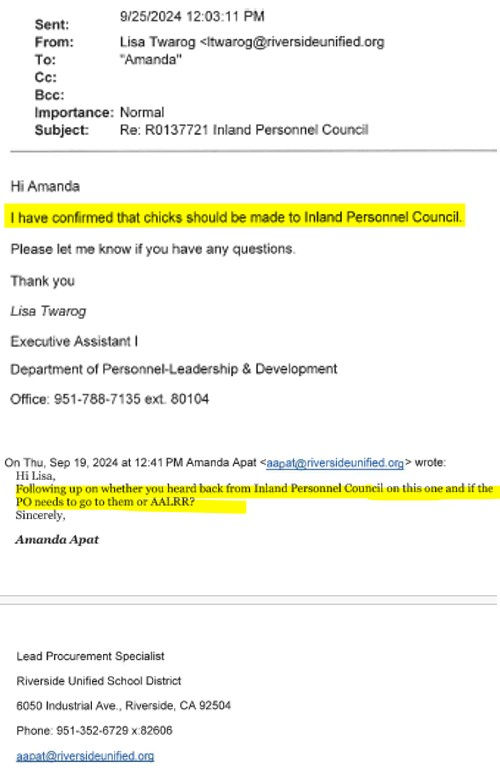
Internal district records show Riverside employees receiving communications directed to “IPC Members,” coordinating attendance at IPC symposiums, and processing IPC-related payments and hotel reservations through district procurement channels.
In an exchange apparently related to conference attendance, a Riverside Unified procurement specialist questioned whether a co-worker had “heard back from Inland Personnel Council on this one and if the PO needs to go to them or AALRR.”
The Department of Personnel-Leadership employee responded: “I have confirmed that the chicks (sic) should be made out to Inland Personnel Council.”
Another Riverside Unified employee communication stated: “Last year they had us submit a PO to someone at AALRR who was handling the reservations…”

Additional records show Riverside Unified created “Inland Personnel Council” as a vendor within the district’s purchasing system using the Riverside AALRR office address.
Superintendent Dr. Sonia Llamas also stated during the meeting that district “cabinet” members
had been reviewing contracts internally over the past several months. Those remarks raise additional questions regarding which contracts are brought before the board for consideration, approval, and public oversight.
Board Member Mr. Kinnear also stated that because IPC was being discontinued, there was no need for an audit of IPC-related expenditures.
That statement concerned one member of the public who watched the meeting and stated:
“How do you say that thousands of taxpayer dollars were being spent for years without boards knowing about it — and then just want to move on as if nothing happened? Where is the accountability? Where is the curiosity as to how this ‘IPC debacle’ occurred across so many school districts in two separate counties?” -- member of the public.
The Riverside Unified School Board meeting follows similar public concerns now raised in Temecula Valley USD, Corona-Norco USD, Redlands USD, and San Bernardino County Board of Education meetings, where board members likewise indicated that IPC had never been meaningfully discussed publicly despite decades of participation and ongoing expenditures of public funds.
Update 5-30-26: Jeff Malan, AALRR Consultant, Blames Public Scrutiny for IPC's Demise, Claims the Private Law Firm is Restructuring the 64-Agency Joint Powers Agreement
In a May 13, 2026 email responding to questions from a Corona Norco Unified School board member regarding the future of the Inland Personnel Council (IPC), Jeff Malan repeatedly characterized public concerns regarding IPC as a "false narrative," accused individuals of "bombard[ing] school districts with numerous requests for public records and other demands," claimed the concerns were based on "false or mistaken premises," dismissed questions regarding IPC as "some sort of government conspiracy which simply does not exist," and suggested the concerns were "fueled only by speculation and a political agenda."
The comments are particularly noteworthy because they come amid years of limited public discussion regarding IPC by the very officials responsible for overseeing it. Despite operating for decades, IPC was rarely, if ever, agendized by the San Bernardino County Board of Education or the Riverside County Board of Education, whose County Superintendents serve as IPC's Executive Officers. In addition, most board members at the 64 agencies were not aware that they were members of IPC. As a result, much of what the public learned about IPC came not from public board discussions, but from Joint Powers Agreements, bylaws, contracts, payment records, and other documents obtained through public-records requests. The May 13 email, sent just days after Malan announced to a select audience of superintendents that IPC would be discontinued and restructured, provides a revealing glimpse into how a consultant to AALRR viewed the growing public scrutiny surrounding the organization.
It's the Public's Fault...
The most striking aspect of the email is not merely Malan's disagreement with members of the public asking questions about IPC, but the apparent disdain with which he characterizes those inquiries and his apparent belief that public scrutiny itself caused IPC's downfall and need for restructuring.
After spending much of the email criticizing public-records requests, social-media discussions, and questions regarding IPC's structure, Malan ultimately concludes that the organization should be wound down because of those lawful public oversight activities. The focus is not on whether the concerns being raised have merit, but on the fact that members of the public were raising them at all.
Malan then directly links those activities to the decision to dismantle IPC, stating:
"to avoid the nuisance of the continuing unwarranted social media attacks, we have concluded that it is best to wind down the Inland Personnel Council in its present form."

Notably, Malan did not state that IPC should be eliminated altogether. Instead, he stated that IPC should be wound down "in its present form." That distinction is significant because elsewhere in the email he indicates that IPC will return in a reorganized structure with "maximum transparency." Thus, while dismissing public concerns as misinformation and conspiracy theories, the email simultaneously acknowledges that the existing structure should be changed.
Further, that explanation is truly remarkable. According to Malan, a decades-old organization involving approximately 64 public agencies is being discontinued not because of any identified fiscal concerns, governance issues, or structural deficiencies, but because members of the public began asking questions about it.

Many of those questions arose only because so little information regarding IPC had been discussed publicly. Despite operating for decades, IPC was rarely, if ever, agendized by the San Bernardino County Board of Education or the Riverside County Board of Education.
If the concerns were truly based on misinformation, the obvious response would have been to publicly explain the structure and correct the record. Instead, neither county board publicly discussed IPC in any meaningful way, and the response described in Malan's email was to discontinue IPC “in its present form.”
In that context, the email creates a remarkable narrative: rather than addressing the questions themselves, Malan portrays the people asking them as the problem—individuals allegedly promoting a "false narrative," advancing conspiracy theories, and pursuing a political agenda, despite the fact that many of the questions arose directly from IPC's own governing documents, contracts, bylaws, and public records.
Malan's Assertions Contradict IPC's Governing Documents
A central theme throughout the May 13 email is that members of the public simply do not understand IPC. Malan repeatedly characterizes public concerns as misinformation, a false narrative, conspiracy theories, and speculation driven by a political agenda.
Yet many of the questions being raised arose directly from IPC's own governing documents, contracts, bylaws, website representations, and public records. In several instances, Malan's description of IPC appears difficult to reconcile with those same documents.
Malan: IPC is "nothing more than a regionally focused facilitator of professional development opportunities for school district HR professionals" and "for 40+ years, the IPC has done nothing more than provide training to school district HR administrators."
IPC Documents: The Joint Powers Agreement states that IPC was established for the purpose of making available "expert legal advice, as well as coordinated services, assistance and information" to participating districts regarding personnel and labor-relations matters. The governing documents further reference legal assistance and advice, personal consultations with districts, negotiation support, mediation, factfinding, salary and bargaining surveys, newsletters, resource materials, and other coordinated services extending well beyond training.
Even Malan's own email contradicts the notion that IPC was merely an HR training consortium. While describing IPC as an organization devoted to HR training, he simultaneously references IPC's role in providing Brown Act and conflict-of-interest training to governing-board members.
IPC's website similarly describes boardsmanship programs for elected officials, support for school-board development activities, and a website where districts could access bargaining information and compare information with other districts.
Likewise, IPC's governance structure bears little resemblance to a simple training consortium. The governing documents establish Executive Officers, an Advisory Committee, bylaws, legal-services agreements, formal withdrawal procedures, recurring member payments, and automatic-renewal provisions—features that would be unnecessary if IPC's sole purpose were hosting occasional professional-development workshops.
Malan: IPC has "never had or attempted to exercise any governmental powers or authority to bind any entity to any action."
IPC Documents: The Joint Powers Agreements provide that participating districts agree to "comply with and be bound by" the bylaws and rules established pursuant to the agreement. The governing documents also authorize the Executive Officers to establish bylaws, appoint the Advisory Committee, execute Agreements for Special Services, administer the Council, and collect payments from participating districts.
Malan: IPC and the County Superintendents have "absolutely no control or influence over any investigation."
IPC Documents: Beginning in 2020, the Agreements for Special Services were expanded to include investigations, post-investigation services, arbitration support, and related personnel matters. While this does not establish influence over any particular investigation, it demonstrates that investigations and post-investigation services became an express part of the services offered through IPC.
Why Was a Private Consultant Speaking for IPC (a group of school districts)?
The May 13 email also raises a broader governance concern regarding why a private citizen with a law firm consulting contract appears to be acting on behalf of “IPC” – the group of school districts engaged in a Joint Powers Agreement.
The email was not written by Executive Officers Ted Alejandre or Edwin Gomez, nor was it approved by the governing boards that collectively comprise IPC. Instead, it was authored by Malan, who signed the correspondence as "Director, Inland Personnel Council" while the SBCSS Communications Director, Jeny Owen confirmed that Malan was serving as a consultant to AALRR, the law firm providing services through IPC.
Throughout the email, Malan repeatedly speaks in the collective voice of the organization, referring to what "we have concluded," describing participating districts as "our members," and referring to AALRR as "our long-time provider." Yet IPC's governing documents define IPC as the participating districts collectively—not a private consultant, the law firm, or any single individual.
Particularly noteworthy is that Malan copied AALRR attorneys Mark Thompson and Todd Robbins while defending IPC, criticizing members of the public, and discussing the future of the organization outside of any public meeting. The email provides no explanation regarding their role, involvement, or why they were included in the correspondence.
The email never explains who made the decision to discontinue IPC, what authority was relied upon, or on whose behalf Malan was speaking. Despite the significance of the decision, neither the San Bernardino County Board of Education nor the Riverside County Board of Education publicly discussed IPC, its discontinuation, or its proposed restructuring. Instead, those developments appear to have occurred largely outside public view and were communicated through correspondence authored by a consultant rather than through any identified public process.
The questions being raised arise directly from IPC's own governing documents, contracts, bylaws, website representations, payment records, and public records—not from conspiracy theories, misinformation, or political agendas.
The May 13 email by a consultant attributes IPC's discontinuation and restructuring to public scrutiny without identifying who actually made that decision or by what authority. Four decades of automatic renewals, legal-services agreements, governance authority delegated to cross-county Executive Officers, and decades of taxpayer-funded expenditures deserve more than accusations of misinformation. They deserve public answers—not criticism of the citizens asking the questions.
Perhaps the greatest contradiction in the email is that while Malan repeatedly dismisses concerns regarding IPC as conspiracy theories, misinformation, and politically motivated speculation, he simultaneously states that IPC should be discontinued "in its present form" and later return with "maximum transparency." If the concerns were truly nothing more than misinformation, why was it necessary to change the structure at all?
------------------------------------------------------------------------------------------
Editor’s Note: This article is based upon publicly available records, governing agreements, public statements made during board meetings, correspondence obtained through public-records requests, and related IPC materials reviewed by EdWatch.net.


Comments